Top 10 Large Diameter Heat Shrink Tubing Products for Heavy-Duty Electrical Insulation and Protection

Good insulation keeps heavy-duty electrical systems from breaking down and costing money. This guide looks at the top 10 large diameter heat shrink tubing products made for tough jobs. Heavy-duty heat-shrink tubing gets that name from high shrink ratios, thick walls, flame retardancy, chemical resistance, and adhesive linings that keep water out. These traits matter most when electrical wiring faces heat, moisture, or abrasion. The top picks include Accupath, 3M, HellermannTyton, TE Connectivity, Panduit, Gardner Bender, Ancor, Qualtek, Alpha Wire, and Nelco. Each product gives dependable performance for harsh environments.
Key Takeaways
Pick a shrink ratio of 3:1 or 4:1 for heavy-duty work. This makes sure it fits tightly around uneven shapes.
Pick the right material for your setting. Polyolefin is good for everyday use, while fluoropolymers like PTFE stand up to extreme heat and chemicals.
Check for certifications such as UL 224 or MIL-DTL-23053. These marks prove the tubing meets safety and performance standards.
Use glue-lined tubing for wet or outdoor jobs. The glue makes a watertight seal that keeps moisture out.
Pick the wall thickness that fits your needs. Thicker walls give better insulation and more protection from damage.
What Makes Heat Shrink Tubing Heavy-Duty?
Key Performance Criteria
Heavy-duty heat shrink tubing gets its name by handling extreme conditions. You will find it in aerospace, defense, marine, and energy jobs where failure is not an option. These products stand up to UV radiation, temperature changes, moisture, chemicals, and physical damage.
The material you pick drives performance. Polyolefin heat shrink tubing works at temperatures above 105°C (221°F) and resists abrasion very well. Fluoropolymer options like PVDF and PTFE give you high-temperature resistance and chemical inertness. PTFE works from −55 to 175 °C, while Viton elastomer goes up to 200°C. These high-performance heat shrinkable materials give you the strength and durability that harsh environments demand.
Material Family | Key Properties |
|---|---|
Polyolefin | Above 105°C; excellent abrasion resistance; flame retardant |
PVC | Limited to 105°C; lower cost |
Fluoropolymer | 40% thinner walls; up to 135°C |
Elastomer | Low-temperature flexibility; fluid resistance |
Certifications tell true heavy-duty products apart from general-purpose ones. UL 224 and CSA C22.2 No. 198.1 cover size, physical, and electrical property requirements for insulating tubing.
UL 224 and CSA C22.2 No. 198.1 are the Underwriters Laboratories and Canadian Standards Association standards for extruded heat shrink and non-heat shrink electrical insulating tubing. These standards were merged into one common standard effective December 2001.
Aerospace and defense projects often need MIL-SPEC qualifications. MIL-DTL-23053 is the highest performance tier, with strict testing for UV, temperature cycling, fluid immersion, and mechanical stress.
Shrink Ratio and Wall Thickness
Shrink ratio tells you how much smaller the tubing gets when heated. A 2:1 ratio cuts the diameter in half. Heavy-duty jobs often need 3:1 or 4:1 ratios. Higher ratios let the tubing fit tightly around odd shapes and different diameters. A 3:1 ratio works well for connectors with uneven profiles. A 4:1 ratio handles complex assemblies with big diameter changes, like military and aerospace connectors.
Wall thickness decides mechanical protection. Thin-wall tubing gives light insulation. Heavy-wall tubing gives maximum durability and abrasion resistance. For 4:1 shrink ratio tubing, the thicker wall left after shrinking gives better mechanical protection and insulation. This makes the tubing very durable and good for heavy-duty protection against moisture, chemicals, and abrasion.
Adhesive-lined dual-wall tubing adds another layer of defense. The adhesive melts during recovery and flows into surface gaps to create waterproof seals. This feature stops water from getting in through capillary action. Your working temperature range, chemical exposure, and cable size all affect the final choice.
Top 10 Large Diameter Heat Shrink Tubing Products
Product 1 — Large-Diameter Dual-Wall Heat Shrink Tubing
Key Specifications
This adhesive lined heat shrink tubing covers cables from 0.4 inches to 7.1 inches wide. It has a 3:1 shrink ratio and a polyolefin jacket. It handles temperatures up to 125°C and voltages up to 600V. The inner adhesive melts just below the shrink temperature of the outer wall. This creates a watertight seal between the outside and the cables inside. You get a strong bond that blocks moisture and weather.
Applications and Pros/Cons
You will find this double-wall heat shrink tubing in underground cable splices, marine wiring, and outdoor junction boxes. The adhesive lining gives great moisture sealing and chemical resistance. The thick wall adds durability against abrasion. However, the adhesive layer makes the tubing stiffer than single-wall heat shrink tubing. This stiffness can slow installation around tight bends. The tubing also costs more than non-adhesive heat shrink tubing. For wet or buried jobs, the waterproof seal justifies the higher price.
Product 2 — Heavy-Duty Thick-Wall Heat Shrink Tubing
Key Specifications
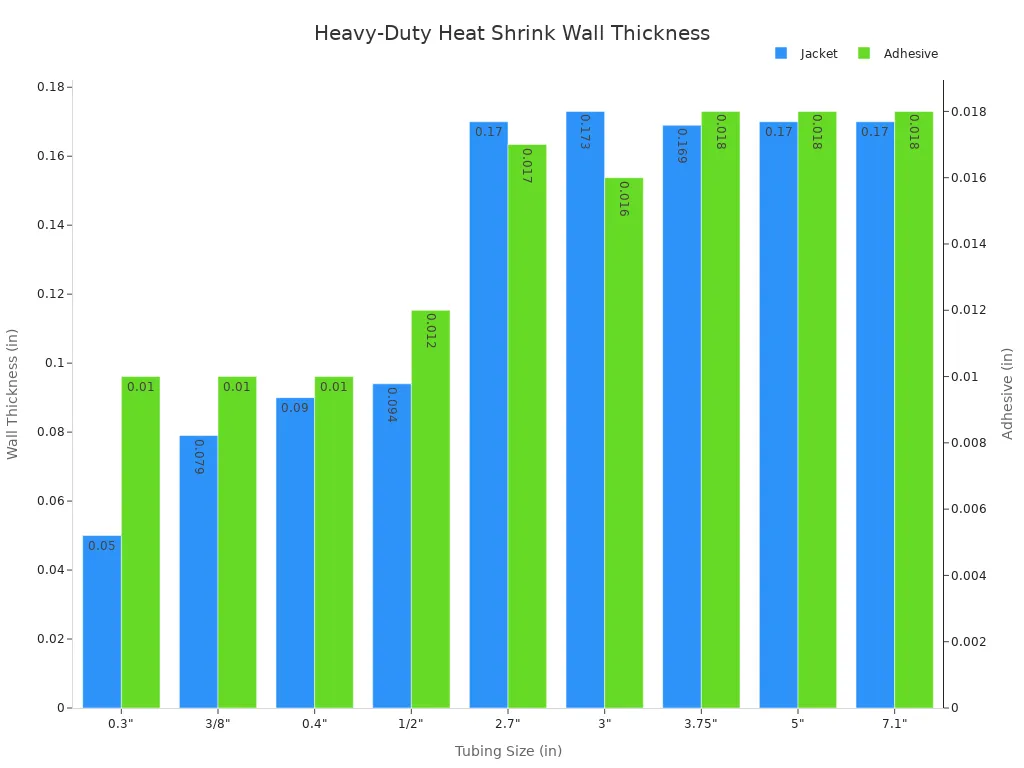
This heavy-wall tubing handles diameters from 0.3 inches to 7.1 inches. It has a 3:1 shrink ratio and a flame-retardant polyolefin jacket. After shrinking, the wall thickness ranges from 0.050 inches on the 0.3‑inch size to 0.17 inches on the 7.1‑inch size. The adhesive layer adds 0.010 to 0.018 inches of thickness. It has a voltage rating of 600V and a breakdown strength of at least 15 kV/mm.
Tubing Size | Wall After Shrink (Jacket) | Wall After Shrink (Adhesive) |
|---|---|---|
0.3" | 0.050" | 0.010" |
1/2" | 0.094" | 0.012" |
3" | 0.173" | 0.016" |
7.1" | 0.17" | 0.018" |
Applications and Pros/Cons
This product works for high-voltage systems, utility cable jointing, and industrial motor connections. The thick wall gives better insulation and mechanical strength. It resists chemicals, UV light, and physical damage. The high breakdown strength protects against electrical shorts, accidental contact, and voltage leakage. On the downside, the tubing is not flexible and does not shrink fast. It needs more heat and time to fully recover. The heavy wall also limits use in tight spaces. Accupath offers a similar heavy-duty option for demanding industrial jobs.
Comparing Heat-Shrink Tubing Options
Key Specifications at a Glance
You need a clear way to see how these products compare. The table below sums up the main specs for all 10 large diameter heat shrink tubing choices. Use it to narrow down your options before you buy.
Product | Diameter Range | Shrink Ratio | Material | Temp Rating | Voltage Rating |
|---|---|---|---|---|---|
Product 1 — Dual-Wall | 0.4"–7.1" | 3:1 | Polyolefin | 125°C | 600V |
Product 2 — Thick-Wall | 0.3"–7.1" | 3:1 | Polyolefin | 125°C | 600V |
Product 3 — Chemical-Resistant | 0.5"–4" | 3:1 | PVDF | 175°C | 600V |
Product 4 — High-Temp Fluoropolymer | 0.3"–2" | 2:1 | PTFE | 175°C | 600V |
Product 5 — Marine-Grade | 0.25"–4" | 3:1 | Polyolefin | 110°C | 600V |
Product 6 — Flexible Elastomer | 0.5"–3" | 2:1 | Elastomer | 150°C | 600V |
Product 7 — Budget Polyolefin | 0.1"–2" | 2:1 | Polyolefin | 105°C | 600V |
Product 8 — High-Voltage Busbar | 1"–6" | 4:1 | Polyolefin | 125°C | 1 kV |
Product 9 — UV-Stable Outdoor | 0.5"–5" | 3:1 | Polyolefin | 125°C | 600V |
Product 10 — Accupath Heavy-Duty | 0.5"–6" | 3:1 | Polyolefin | 125°C | 600V |
How to Choose Based on Project Needs
Where you use it decides what you pick. If you need strong chemical resistance, go with PVDF or PTFE heat-shrink tubing. These materials hold up against fuels, hydraulic fluids, and harsh solvents. For underwater jobs, pick dual-wall adhesive-lined heat shrink tubing. The adhesive forms a watertight seal that keeps moisture out. For high-voltage systems, make sure it has at least a 1 kV rating. Standard 600V tubing is fine for general electrical work. If you are watching your budget, single-wall polyolefin heat shrink tubing gives you good insulation for less money.
Always look at agency certifications before you buy. UL 224 and CSA C22.2 No. 198.1 show that a product meets safety and performance standards. MIL-DTL-23053 marks the top tier for aerospace and defense. Material compatibility is important too. A recovered inner diameter that is too tight can crack the tubing. Test a sample in a pre-production trial to check fit and repeatability. The right heat-shrink tubing gives you the right mix of durability, strength, and resistance for your job.
For the best all-around choice, pick Product 1. This dual-wall heat shrink tubing gives waterproof seals and tough insulation. Product 3 offers great chemical resistance for hard solvents and fuels. For very hot conditions, choose Product 4 with PTFE material. It handles 175°C without damage.
The heat shrink tubing you choose depends on your project needs. Look at the environment, voltage, and cable size first. Make sure the shrink ratio fits your cable range. Check that the material works with any chemicals nearby. Find UL 224 or CSA certification marks on the package.
Using good heat shrink tubing now keeps you from costly problems later. This heat shrink tubing gives dependable performance and long-lasting protection for your electrical systems.
FAQ
What does the shrink ratio tell you about a product?
Shrink ratio tells you how much the tubing gets smaller when heated. A 3:1 ratio means the diameter becomes one-third of the original size. Heavy-duty jobs often need 3:1 or 4:1 ratios so the tubing fits tightly around uneven connectors and complex shapes.
Which material works best for very hot environments?
PTFE can handle temperatures up to 175°C without damage. PVDF works well up to 175°C and resists fuels and solvents. Polyolefin reaches its limit near 125°C. Choose fluoropolymer heat-shrink tubing when heat or chemical exposure is high.
How do you know a product meets heavy-duty standards?
Look for UL 224 and CSA C22.2 No. 198.1 marks on the package. These standards cover size, physical, and electrical requirements. Aerospace and defense projects often need MIL-DTL-23053, which tests UV, temperature changes, fluid contact, and mechanical stress.
When should you choose adhesive-lined tubing?
Pick adhesive-lined tubing for wet, buried, or outdoor jobs. The inner adhesive melts during shrinking and flows into surface gaps. This creates a watertight seal that blocks moisture. The downside is higher cost and less flexibility around tight bends.
Does wall thickness affect electrical safety?
Yes. Thick-wall tubing gives better insulation and mechanical strength. It resists chemicals, UV light, and physical damage. A high breakdown strength protects against electrical shorts and voltage leaks. Thin-wall tubing only gives light insulation, so match wall thickness to your environment and voltage needs.
See Also
Applications Of Heat Shrink Tubing For Electrical Wire Insulation
Leading Brands Offering FEP Sterilizable Heat Shrink Tubing Solutions
Comparing Leading Brands Of FEP Heat Shrink Tubing Products
Difference Between Medical And Industrial Grade Heat Shrink Tubing
Guide To FEP Non-Toxic Heat Shrink Tubing For Industrial Applications

© Copyright 2024 My First Blog - All Rights Reserved.