Understanding Polyimide Tubing for Medical Device Applications

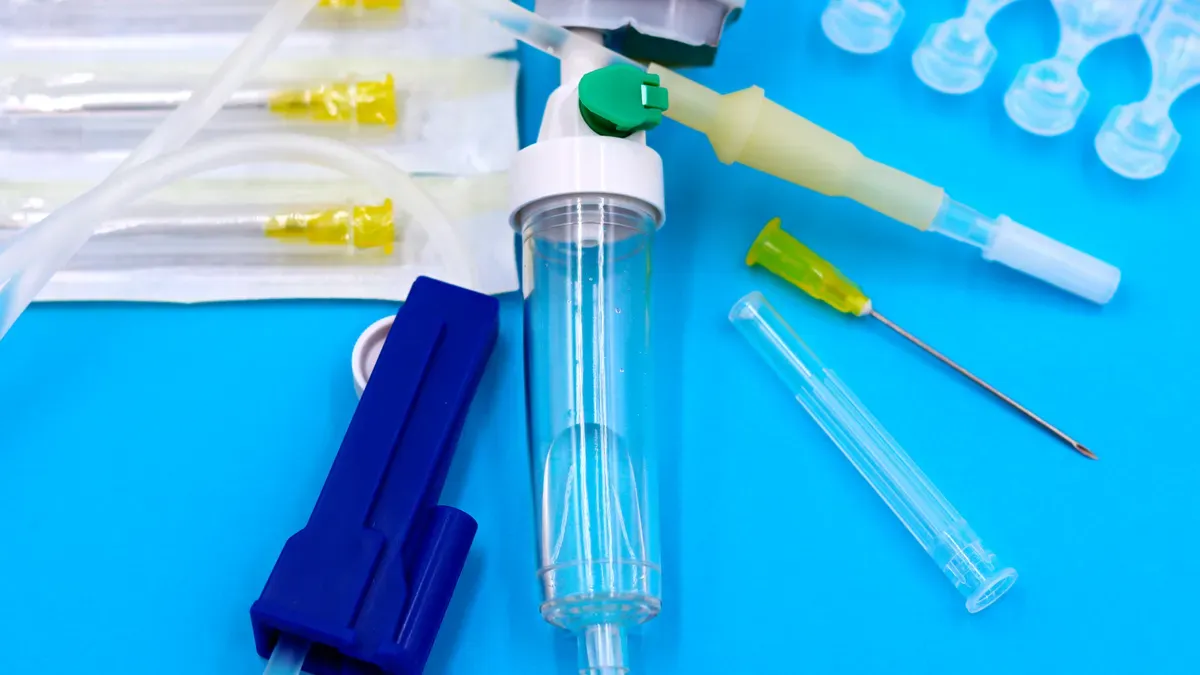
A film-casting process makes polyimide tube medical devices with thin walls and high strength. This thermoset plastic is used in vascular catheters, balloon catheters, and steerable catheters. The material stands up to high pressure and tight spaces. Its inertness and dimensional stability help it work reliably in clinical settings. These properties let engineers design smaller tools that move through the body safely. Minimally invasive procedures benefit from the tubing's ability to hold its shape under stress. The manufacturing process ensures exact inner diameters needed for device compatibility. As a result, doctors get better patient outcomes with fewer complications. This material is still a top choice for advanced medical device design. During this process, layers of liquid polymer cure to form a seamless tube. The result is a thin, strong tube that resists kinking. Its use in steerable catheters allows precise navigation through winding pathways.
Key Takeaways
Polyimide tubing is strong and thin, so it works great for small medical devices.
It stands up to high heat and chemicals, so it works well inside the body.
You can add braids or coils to make it even stronger and more flexible.
Laser cutting makes exact holes and leaves no leftover bits.
Picking the right kind of polyimide tubing helps doctors do better procedures.
Polyimide Tubing in Medical Device Applications

What Is Polyimide Tubing?
Polyimide tubing is a thermoset plastic made by layering and film casting, not by extrusion. This way of making the tube builds it up in thin layers. Each layer cures into a seamless wall. The result is a strong, thin-walled tube with exact dimensions. Engineers use polyimide tube medical devices because the material resists heat, chemicals, and deformation. Thermoplastics melt and reform, but a thermoset like polyimide keeps its shape once cured. This matters a lot in high-precision medical catheters where steady inner diameters are key. The film-casting process allows wall thicknesses as thin as 0.0002 inches. That thinness leaves more room for the lumen, so doctors can deliver fluids, guidewires, or implants through tighter spaces. Polyimide also provides electrical isolation for conductive elements inside a catheter. These features make polyimide tubing in medical device applications a dependable choice for vascular, neurological, and urological procedures.
Polyimide Tube Medical Catheter Applications
Polyimide tube medical catheters show up in many device types. Balloon catheters use polyimide for inflation lines. A fused polyimide layer cuts down elongation and compression of the composite elastomer. Steerable catheters depend on polyimide for pull wire lumens. That lumen guides the wire that bends the tip during navigation. Single or multi-lumen catheters often use polyimide-lined lumens to keep patency. Retrieval devices also gain from the material's stiffness and kink resistance. The medical device applications for this tubing reach into diagnostic and therapeutic tools. Market data shows steady growth. The Medical Polyimide Tubing market is expected to grow at a compound annual growth rate of 4.3% during 2026–2033. Another projection cites 8.2% CAGR, driven by robotic surgery and drug-eluting stents. These numbers show rising adoption of minimally invasive procedures.
Designers of reinforced shafts must balance many variables. A reinforced shaft usually has an inner liner, a braid or coil reinforcement layer, and an outer jacket. These elements must fit together within strict dimensions.
Catheters and other tube-based medical devices requiring high torque response, burst pressure, pushability, steerability and kink resistance typically feature a braid or coil-reinforced shaft design. Multiple variables are at play when designing reinforced shafts. Generally, a reinforced shaft has an inner liner, a braid or coil reinforcement layer(s) and an outer jacket. These elements must be married together to achieve required dimensions while accounting for inherent physical limitations such as liner thickness, outer jacket thickness, and wire density (defined as pic per inch for braid or pitch for coils).
The table below sums up common catheter types and how they use this material.
Catheter Type / Application | Use of Polyimide Tubing |
|---|---|
Balloon catheters | Inflation lines; fused polyimide reduces elongation and compression of the composite elastomer |
Steerable catheter products | Pull wire lumen |
Single or multi-lumen catheters | Polyimide-lined lumens |
Conductive elements | Electrical isolation |
Polyimides are a class of high performing polymers known for their exceptional chemical, thermal and mechanical performance properties. Medical applications, especially in the construction of vascular and urinary catheters, use polyimides extensively. Braid and coil reinforced polyimide tubing helps device engineers optimize their catheter designs by fine-tuning key properties such as torqueability, flexibility, kink resistance, strength, and pushability.
Key Properties of Polyimide Tubing
This tubing gives a special set of features for tough jobs. The material has high heat resistance, creep resistance, and very exact sizes. These traits let engineers make smaller, more trusted devices. The features help performance in high-pressure settings. Two key areas stand out: structural and thermal stability, and size stability with chemical resistance.
Structural and Thermal Stability
Polyimide can handle temperatures up to 400°C. This high heat resistance lets the material survive cleaning steps without damage. Common methods like autoclaving and ethylene oxide gas do not harm it. The material does not melt or soften like thermoplastics. It keeps its shape under extreme conditions. Creep resistance is another big plus. Under constant load, the material does not change shape over time. This mechanical reliability makes sure a device works as planned during long procedures. The material does not relax or lose shape under ongoing stress. This property is key for tools that stay in the body for a long time. The material also offers strong structure. This comes from the thermoset nature of this polymer. Once cured, the polymer chains form a stiff network. This network resists crushing and bending forces. The result is a tube that stays open even under high outside pressure. This property is key for balloon devices that must handle inflation forces without collapsing. Engineers use this strength to make thin-walled tools that move through twisty paths. Thin walls mean larger inner channels for fluid or guidewire passage. Larger channels improve flow rates and allow bigger guidewires. This design freedom helps surgeons do complex procedures with smaller entry points. The heat resistance also helps bonding and assembly steps. Makers can apply heat without damaging the material. This allows thermal bonding methods for multi-layer construction.
Dimensional Stability and Chemical Resistance
Size stability sets this material apart from others. The material holds exact sizes even after heat, moisture, or stress. For tools, a steady inner size is vital. A steady inner size ensures smooth passage of guidewires and fluids. The material gets this steadiness through the film-casting process. The table below shows typical tolerance limits across standard AWG sizes.
AWG | Outer Diameter Tolerance (mm) | Outer Diameter Tolerance (microns) | Wall Thickness Tolerance (mm) | Wall Thickness Tolerance (microns) |
|---|---|---|---|---|
18 | ±0.00762 | ±7.62 | ±0.00762 | ±7.62 |
19 | ±0.00762 | ±7.62 | ±0.00762 | ±7.62 |
20 | ±0.00762 | ±7.62 | ±0.00762 | ±7.62 |
21 | ±0.00762 | ±7.62 | ±0.00762 | ±7.62 |
22 | ±0.00762 | ±7.62 | ±0.00762 | ±7.62 |
23 | ±0.00762 | ±7.62 | ±0.00762 | ±7.62 |
24 | ±0.00762 | ±7.62 | ±0.00762 | ±7.62 |
25 | ±0.00762 | ±7.62 | ±0.00762 | ±7.62 |
26 | ±0.00762 | ±7.62 | ±0.00762 | ±7.62 |
27 | ±0.00762 | ±7.62 | ±0.00762 | ±7.62 |
28 | ±0.00762 | ±7.62 | ±0.00762 | ±7.62 |
29 | ±0.00762 | ±7.62 | ±0.00508 | ±5.08 |
30 | ±0.00762 | ±7.62 | ±0.00508 | ±5.08 |
31 | ±0.00508 | ±5.08 | ±0.00508 | ±5.08 |
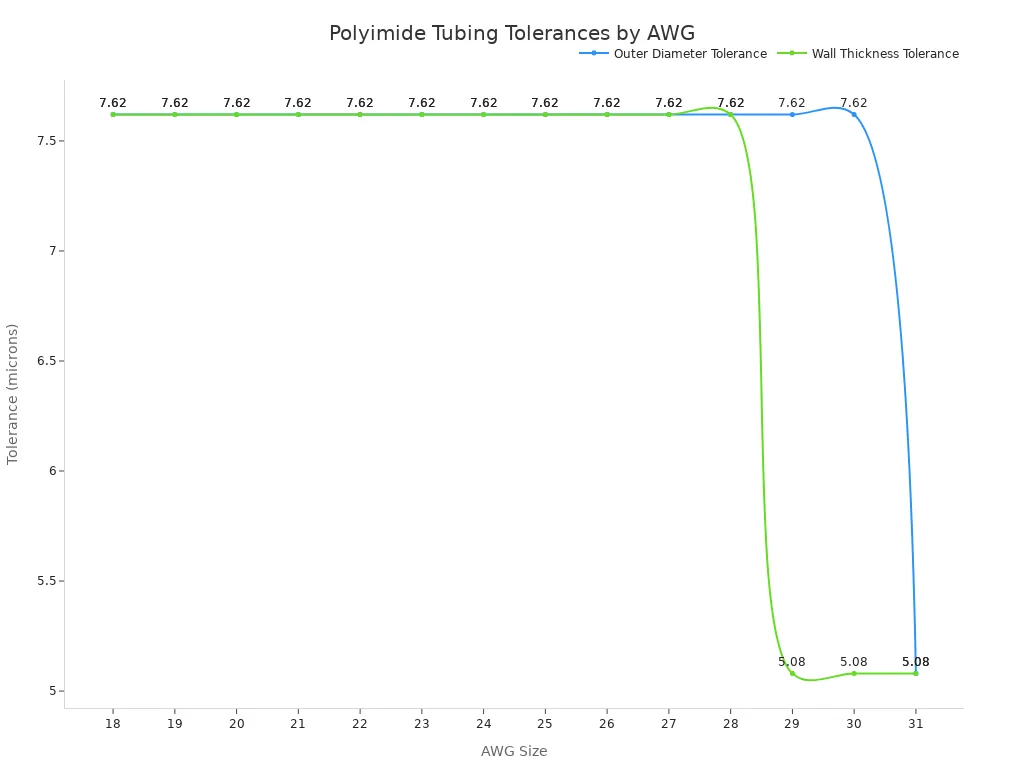
These tolerances, measured in microns, show how exact this material can be. For AWG sizes 18 through 28, the outer diameter tolerance stays at ±7.62 microns. The wall thickness tolerance holds at ±7.62 microns through AWG 28. For smaller sizes, tolerances get even tighter. AWG 31 reaches ±5.08 microns for both outer diameter and wall thickness. This precision helps miniaturization in device design for polyimide tube medical uses. Engineers can pick exact sizes for each part. The tight tolerances ensure steady performance across production batches. Each batch of this material meets the same demanding standards. This steadiness makes the manufacturing process simpler for device assembly.
Chemical resistance adds another layer of trust. The material resists harm from clinical fluids, solvents, and body fluids. The material does not swell or break down when exposed to these substances. This inertness makes it good for implantable devices. Biocompatibility testing confirms it is safe for long-term contact with tissue. The material also withstands exposure to contrast agents and drug formulas. The material also resists hydrolysis, which can break down other polymers in wet conditions. This resistance ensures long-term performance in contact with blood or other body fluids. This chemical stability prevents contamination of the treatment area. Size stability critical to catheter performance ensures that the tool works correctly every time. The mix of strength and size stability gives engineers confidence in their designs. Together, these properties make this material a top choice for advanced tools.
Reinforcement Options for Polyimide Tubing
Braided and Coil Reinforcement
Engineers add braided and coil reinforcements to polyimide tubing to make it stronger. A braided layer boosts burst pressure resistance, column strength, and torque transmission. These features improve flexibility, kink resistance, and trackability during navigation. The wire matrix gives structural support that keeps the lumen open even at sharp bend angles. This structural integrity helps the tube resist crushing and ovalization under pressure.
Braid angle plays a big role in performance. A smaller braid angle gives higher column strength and torque transmission. A larger braid angle provides greater kink resistance and stretchability. Variable braiding lets engineers place a higher angle at the distal end for flexibility and a lower angle at the proximal end for pushability. Wire material also matters. Stainless steel grades like 304V and 316LVM offer maximum tensile strength and burst resistance. Nitinol provides superelasticity and extreme kink resistance. Tungsten and platinum iridium deliver high radiopacity for fluoroscopic visibility. Synthetic fibers such as Kevlar and Vectran offer MRI compatibility.
Braid Angle | Column Strength | Torque Transmission | Kink Resistance | Stretchability |
|---|---|---|---|---|
Smaller braid angle | Higher | Higher | Lower | Less |
Larger braid angle | Lower | Lower | Greater | More |
PTFE‑Polyimide Composite Tubing
A composite tubing that combines ptfe and polyimide pairs two high-performance materials in one construction. The polyimide layer supplies thin walls, high dielectric strength, and resistance to pressure expansion. The PTFE layer adds lubricity and chemical inertness. This composite medical tubing design lets engineers tune the inner and outer surfaces for different needs. One surface can prioritize wire movement while the other handles tissue contact.
Composite medical tubing built this way supports reinforced tubing designs with braid or coil layers between the two materials. The polyimide liner stays ultra-thin, which maximizes internal lumen capacity. The PTFE jacket reduces friction during device advancement. Together, these layers create a balanced shaft with strong flexibility, kink resistance, and trackability. This construction suits catheters that must navigate tortuous anatomy without losing pushability.
Laser Machining of Polyimide Tubing
Laser Cutting and Drilling Benefits
Laser machining lets engineers cut and drill polyimide tubing in a clean way. Mechanical drilling leaves chips, fragments, and raised ridges behind. Laser drilling turns material into vapor right away, so almost no debris is left. Ultrafast laser drilling makes smooth edges on the top and bottom of each hole. You do not need grinding or polishing to remove raised edges. This process keeps the heat-affected zone and mechanical stress very small. Damage to the substrate stays limited to just microns. Holes placed close together work fine without interfering with each other. One documented case drilled 50-micrometer holes in braided polyimide medical tubing. It needed no charring, melting, damage to nearby areas, or post-processing. Femtosecond laser drilling limits thermal damage because pulses hit the material faster than heat can spread. This gives smooth inner walls, few burrs, less debris buildup, and a better surface finish. Edge defects affect how well medical devices work and how reliable they are, so this quality really matters.
Aspect | Mechanical Drilling | Laser Drilling |
|---|---|---|
Debris | Creates chips, fragments, and raised ridges | Vaporizes material instantly, reducing or eliminating debris |
Edge quality | Leaves rough burrs that can catch tissue or alter fluid dynamics | Produces burr-free holes without raised slag or recast material |
Post-processing | Often requires secondary cleaning such as acid-washing, chemical etching, or deburring | Can often skip secondary cleaning, shortening cycle times and reducing chemical waste |
Custom Features for Medical Applications
Laser machining hits tight dimensional accuracy across many material thicknesses. The table below shows typical tolerances for hole diameter.
Material Thickness | Typical Tolerance |
|---|---|
Up to 0.5 mm | ±0.05 mm |
0.5 mm – 2.0 mm | ±0.1 mm |
2.0 mm – 5.0 mm | ±0.15 mm |
5.0 mm – 10.0 mm | ±0.2 mm |
10.0 mm and above | ±0.3 mm |
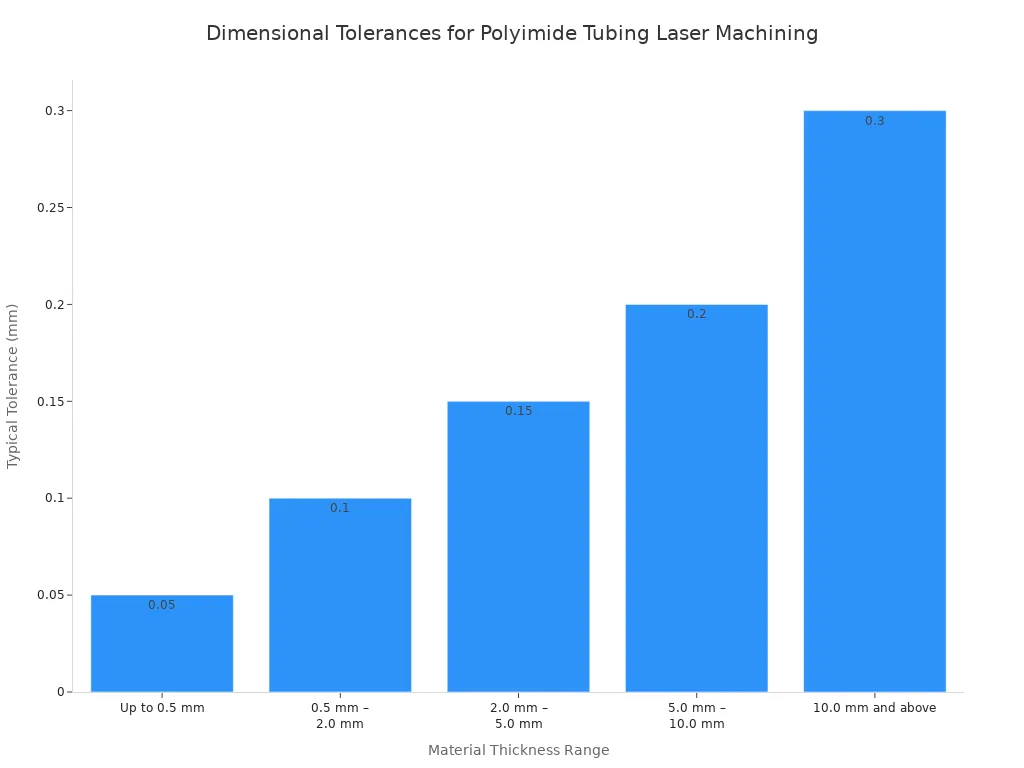
UV lasers can reach tolerances as tight as ±0.0001 inches because of their short wavelength and ultra-fine beam. General laser cutting tolerances run from ±0.005 to ±0.010 inches for metals and ±0.001 to ±0.005 inches for non-metals. A-Laser's standard cutting accuracy can go down to ±0.0005 inches on most compatible materials. For some metals, UV lasers reach tolerances as low as ±0.0005 inches (0.013 mm).
For polymer laser cutting of materials including polyimide, features and tolerances can be achieved down to 15 microns.
These abilities support high-precision medical tubing with complex hole patterns, slots, and custom shapes. Engineers get the precision to place micro-perforations for drug delivery or sensor windows. The precision also helps create custom tip shapes and side ports. This flexibility lets designers tailor each tube to specific clinical needs.
Polyimide Material Selection for Medical Devices
Evaluating Performance Trade‑offs
Choosing the right grade means balancing mechanical properties that compete with each other. Standard polyimide bends easily and fits into small spaces, but its kink resistance and strength are only moderate. Polyimide coated tubing gives good kink resistance and high surface durability, which helps with tracking and turning. Polyimide composite tubing offers the highest kink resistance and strength, but it does not bend as easily. This trade-off is important for complex, high-performance catheter designs. When you increase strength and kink resistance, flexibility goes down. When you maximize flexibility, column strength and kink resistance drop. Braid pattern adds one more variable. A lower braid pattern makes pushing easier, while a higher braid pattern improves bendability. Coil reinforcement resists collapse and buckling. Braid reinforcement improves burst strength and torque transmission, but you lose some flexibility. Composite tubing brings together the good traits of several materials into a better catheter.
Tubing Grade | Flexibility | Kink Resistance | Strength / Stiffness | Pushability & Torque | Best-Fit Medical Use |
|---|---|---|---|---|---|
Standard Polyimide | High | Moderate | Moderate | Good | Catheters, sensors |
Polyimide Coated | Moderate | Good | High surface durability | Improved tracking and turning | Implants, guidewire lumens, insulated lead wires |
Polyimide Composite | Lower | Highest | Highest | Best for high-stress navigation | Vascular catheters, advanced high-stress tools |
Tailoring Tubing to Application Needs
Engineers pick the grade that fits the clinical task. A sensor or diagnostic catheter may need standard polyimide for flexibility. An implant or guidewire lumen does better with coated tubing for smooth tracking. A vascular catheter that moves through twisted anatomy needs composite tubing for the most kink resistance and strength. Dimensional stability keeps the inner diameter exact across all these choices. This precision supports mechanical reliability during long procedures. Each choice affects trackability, pushability, and torqueability for endovascular use. The right tubing grade lets designers reach specific performance goals without hurting how the device works overall.
Polyimide tube medical designs mix thin walls, high strength, thermal stability, and exact sizes. These key traits directly help make advanced medical devices possible. Braided and coil reinforcement let engineers boost torque response and kink resistance for specific clinical needs. PTFE composite constructions add lubricity for smoother navigation through winding anatomy. Laser machining creates precise custom features like holes and slots without debris. Every catheter gains from these abilities. Catheters for complex procedures depend on this material for steady navigation and mechanical reliability. The material supports minimally invasive device design through ongoing miniaturization and thinner walls. Surgeons can reach smaller targets with fewer problems. Next-generation medical technologies will grow this material's role in robotic systems, drug-eluting stents, and complex delivery tools. Engineers keep finding new uses for this versatile material in medical instruments.
FAQ
How thin can polyimide tubing walls get?
The film-casting process makes walls as thin as 0.0002 inches. This thinness gives more room inside the tube. Doctors can then pass guidewires or fluids through tighter paths in the body.
What temperatures does polyimide tubing handle?
Polyimide tubing can handle temperatures up to 400°C. This heat resistance lets the material survive autoclaving cycles. Other medical plastics melt or soften at much lower temperatures.
Can engineers add reinforcement to polyimide tubing?
Yes. Braided or coil reinforcement layers boost burst pressure, torque transmission, and kink resistance. Engineers adjust braid angle and wire material. These choices tune performance for specific clinical needs.
What composite options exist for polyimide tubing?
PTFE-polyimide composite tubing pairs polyimide strength with PTFE lubricity. The polyimide layer supplies thin walls and pressure resistance. The PTFE layer creates a slippery surface for smoother device advancement through the body.
See Also
Key Applications Of Ultrathin-Wall PET Heat Shrink Tubing In Medical Devices
New And Emerging Trends In FEP Heat Shrink Tubing
Choosing The Best FEP Shrink Tubing For Class III Devices
A Complete And Ultimate Guide To Medical Grade FEP Tubing
Why Ultra-Thin PET Heat Shrink Tubing Is Crucial For Medical Devices

© Copyright 2024 My First Blog - All Rights Reserved.