Hypo Tubing Manufacturing: From Raw Materials to Finished Products

Hypo tubing, also called hypodermic tubing, is a very thin and precise metal tube. It is used as the shaft or support structure in medical tools like catheters and stents. This article explains the complicated steps of Hypo Tubing Manufacturing, from choosing raw materials to final quality checks. You need a trustworthy technical guide to help with design and buying choices. Your device's performance—such as pushability, kink resistance, and torque response—is directly linked to how it is made. We will go through materials, processes, and specs step by step, so you can make informed decisions.
Key Takeaways
Use 316 stainless steel when it touches body fluids, so it won’t rust or corrode.
With drawing and heat treatment cycles, tubes become stronger and more flexible.
Use ASTM A908 rules to get exact tube sizes and how well the tube works.
Work with a supplier that handles every step, so you can control quality from start to finish.
Key Steps in Hypo Tubing Manufacturing
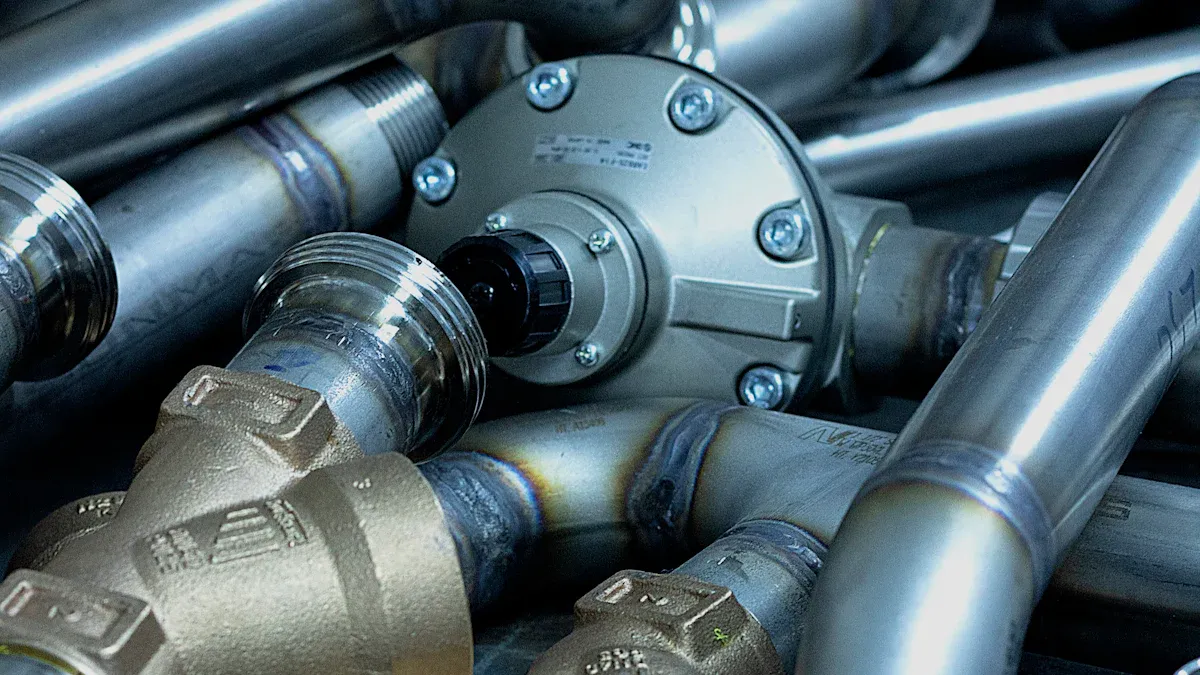
Raw Materials: The Role of Stainless Steel Grades
Your hypo tubing journey begins with large sheets of thin stainless steel. Manufacturers typically use grade 304 or 316 stainless steel. They cut these sheets into uniform strips. The strip width matches your tube size.
The choice between 304 and 316 directly affects your device's corrosion resistance. Here is the critical difference:
304 and 316 stainless steel differ primarily through molybdenum content. 316 contains molybdenum, but 304 does not. This alloying element drastically enhances corrosion resistance, especially for saline or chloride-exposed environments. Typical medical uses for 316 include hypodermic needles, implants, and stents.
The 2-3% molybdenum content in 316 strengthens the passive chromium oxide layer on the metal surface. This layer makes 316 far more resistant to chloride ions. Chloride ions drive pitting corrosion in stainless steel. Pitting creates localized holes that can compromise a sealed fluid path inside your device. For products with prolonged body fluid contact, 316L provides a meaningful safety margin that 304 cannot offer. 304 remains the industry standard for external-use needles with minimal chloride exposure. However, bodily fluids contain chloride ions. Therefore, 316 is the preferred choice when exposure to acids or salts is likely. Hypo Tubing Manufacturing requires careful material selection because the wrong grade leads to premature device failure inside a patient. Selecting the correct grade before production begins prevents costly requalification later.
Core Processes: Welding, Drawing, and Heat Treatment
Once you have uniform strips cut to width, the forming process in Hypo Tubing Manufacturing begins. A machine rolls each strip into a cylindrical tube shape. Then, workers weld the longitudinal seam to close the tube permanently. TIG welding is the most common method for thin-walled hypodermic tubing. According to industry documentation, the TIG welded and plug-drawn process has been the gold standard for all medical grade tubing since the 1960s. Competing processes like laser welding have tighter manufacturing constraints and a higher potential for defective tubes. TIG welding remains the predominant choice for reliable seam integrity.
After welding, the tube enters the drawing process. This step is the heart of Hypo Tubing Manufacturing. Drawing pulls the tube through a series of carbide dies. Each die reduces the outer diameter and inner diameter simultaneously. This process does more than resize the tube. Drawing work-hardens the stainless steel, enhancing its mechanical properties. You gain improved pushability, kink resistance, and torque response. These properties determine how well your catheter or stent performs during a clinical procedure. Each draw pass reduces the cross-section by a calculated percentage. Too aggressive a reduction causes tearing or cracking. Too conservative a reduction requires extra passes. Experienced manufacturers optimize this rate for each material grade. They also control the pull speed and lubrication to ensure consistent results.
Drawing creates internal stress in the metal. The tube becomes stronger but also more brittle. Heat treatment reverses this brittleness. You stress-relieve the tube through controlled heating in a furnace. The annealing temperature varies by grade. 304 and 316 require different heat cycles. Proper heat treatment restores ductility so the tube can withstand further processing. The combination of drawing and heat treatment repeats multiple times. Each cycle brings the tube closer to your final specifications. Operators inspect dimensions after every cycle. They measure OD, ID, and wall thickness. Any deviation triggers adjustment before the next pass. This rigorous process control ensures your finished tube meets exact requirements. Manufacturers document every cycle for full traceability back to the original material lot.
Achieving Precision and Quality Control
Critical Dimensions and Tolerances
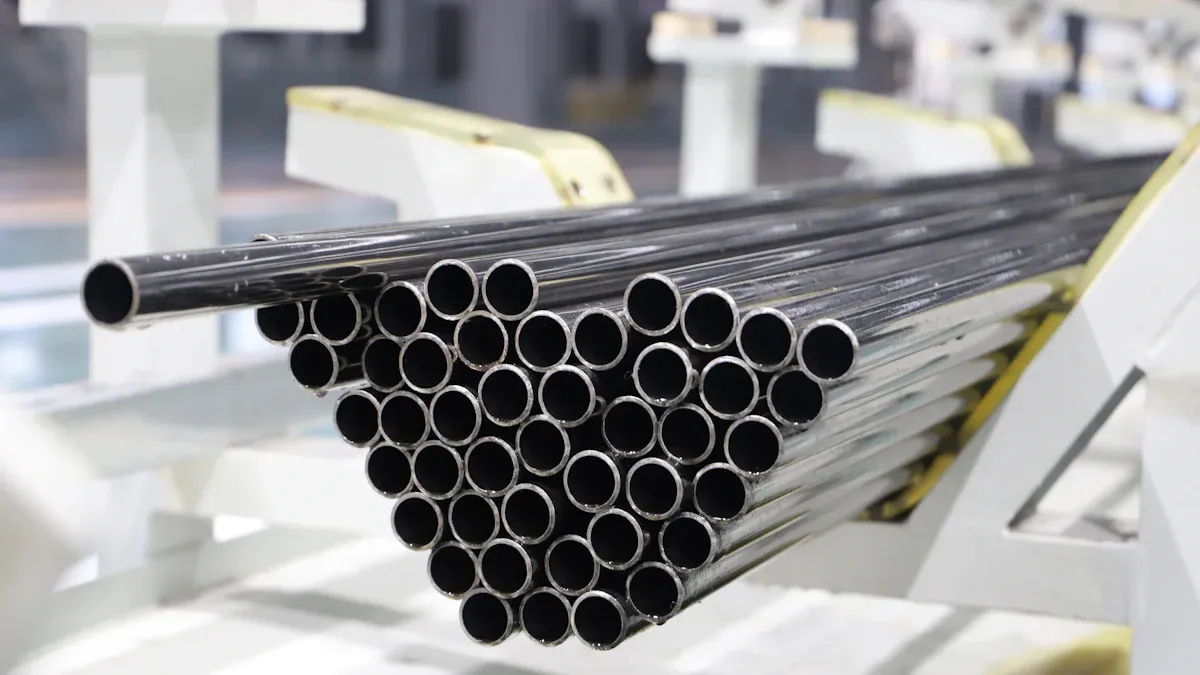
The drawing process is how we get very accurate measurements in Hypo Tubing Manufacturing. Your tube's outer diameter and inner diameter must be exact. These sizes directly affect how your device works. A tube that is not within the required range will not work properly in a medical procedure. Your catheter's pushability, kink resistance, and torque response all depend on exact sizes.
The industry uses ASTM A908, the standard for hypodermic tubing. This standard sets the allowed size limits for each gauge. Manufacturers use these numbers as their starting point for quality.
Gauge | OD (in.) | OD Tolerance (±in.) | Wall (in.) | Wall Tolerance (±in.) |
|---|---|---|---|---|
6 | 0.203 | 0.001 | 0.015 | 0.001 |
10 | 0.134 | 0.001 | 0.014 | 0.001 |
14 | 0.083 | 0.001 | 0.010 | 0.001 |
18 | 0.050 | 0.0005 | 0.0085 | 0.0005 |
22 | 0.028 | +0.0005/-0.000 | 0.00625 | +0.000/-0.0005 |
26 | 0.018 | +0.0005/-0.000 | 0.00425 | +0.000/-0.0005 |
30 | 0.012 | +0.0005/-0.000 | 0.003 | 0.00025 |
As gauge numbers get bigger, the allowed error gets smaller. Larger gauges from 6 to 14 have an OD tolerance of ±0.001 inches. Smaller gauges from 15 onward tighten to ±0.0005 inches. The smallest gauges use tolerances that only allow positive change. This means you can count on a steady fit for your device assembly.
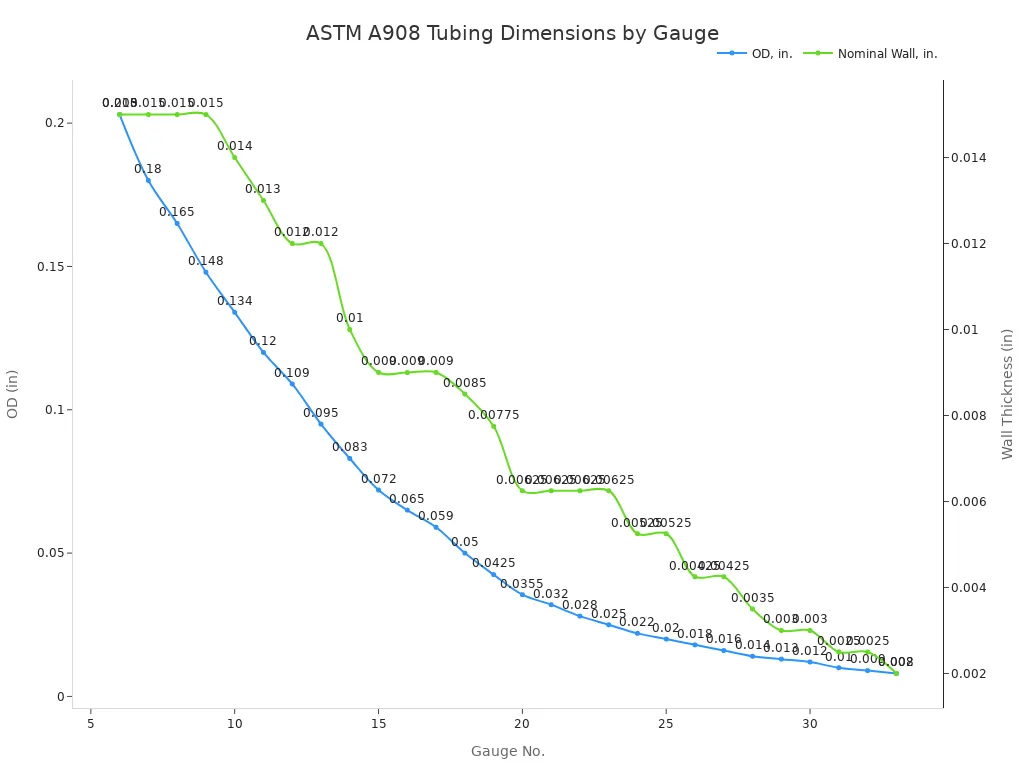
Inner diameter tolerances also change with gauge and wall thickness. Typical values go from ±0.001 inches to ±0.003 inches. Some sizes use asymmetric tolerances like +0.001/-0.0005 inches. These tiny numbers matter because the ID controls the fluid path through your device.
The ID tolerances vary by gauge and wall thickness, with typical values such as ±.001, ±.0015, ±.002, ±.003 inches, and asymmetric tolerances like +.001/-.0005, etc.
Changes in ID greatly affect fluid flow. Poiseuille's law shows that cutting the tube radius in half makes flow resistance 16 times larger. For small gauge tubes, even a small ID change within the allowed range can greatly reduce flow rate. You may need much higher pressure to keep the desired flow during a procedure.
Manufacturers use high-speed laser digital micrometers to measure these sizes. This non-contact method is accurate to ±0.000039 inches. It takes away all human mistakes. Operators set alarm limits so the system marks any tube that is out of spec right away.
Technique | Accuracy | Key Advantage |
|---|---|---|
High-speed laser digital micrometer (non-contact) | ±0.000039 inches | Eliminates human error; alarm-setting for tolerance limits |
Contact measurement (hand micrometer/caliper) | ±0.0001 inches (best case) | Not specified |
Laser measurement gives you much better accuracy for checking hypo tubing sizes. This matters most for small gauge sizes where even 0.0001 inches can affect your device's performance.
Testing and Industry Standards
Quality control also needs mechanical testing. ASTM A908 requires tension tests to make sure the tubing meets strength requirements. This confirms your tube can handle the forces during use. A catheter shaft must push through tight vessels without buckling. The tension test checks this ability.
Manufacturers also check the weld area with eddy current testing. An electrical coil creates an electromagnetic field in the tube and makes eddy currents. When there is a crack or defect, the eddy currents flow around it and change the local magnetic field. The coil detects this change and sends a defect signal. The system then takes out the defective part automatically. This check finds flaws that visual checks would miss.
An eddy current test coil uses alternating current to create eddy currents in the tube. As the tube goes through the coil, short problems in the weld zone change the eddy current pattern. The instrument detects this change and marks the flaw. The manufacturer puts this system right before the cutting stage. It finds defects in both the weld and the base material.
Vertically integrated manufacturing gives you better control over quality. The same facility draws the tube, does laser cutting, and runs final inspection. Every step meets strict specs. Your finished hypotube part passes all quality checks from start to finish. This integration lowers the risk of miscommunication or tolerance build-up between different suppliers.
Customization, Applications, and Selection
Fabrication Options and Laser Cutting
Custom fabricated hypo tubing parts come in many forms. You can order simple cut-and-deburred tubes for basic catheter shafts. You can also request complex devices with detailed features for special procedures. Your design options include several forming operations:
Flare: Makes a transition, guide, or stopper. The largest flare diameter reaches about 20% of the OD, based on wall thickness.
Reduced swage: Makes the tube narrower for tight joints.
Swage: Shapes the tube into a smaller cross-section.
Additional options: Bend, bulge, chamfer, dimple, expand, flange, groove, taper, and thread.
Laser cutting turns straight tubing into flexible, steerable parts. Precision laser systems remove material in planned patterns. Each pattern gives different performance traits:
Pattern Type | Flexibility Mechanism | Clinical Application |
|---|---|---|
Helical/Spiral | Steady flexibility for moving through twisted anatomy | GI endoscopes |
Hinge-like motifs | Bending at specific points | Devices navigating sharp bends |
Diamond lattice | Diagonal bridges for strong torsional stiffness | Therapeutic catheters |
Functional gradients | Tight pitches at the tip; thick struts near the base | Multi-purpose devices |
After cutting, electropolishing removes sharp recast edges that could crack during repeated bending. Controlled passivation follows to keep structural strength. Simulation and fatigue testing confirm each pattern design works.
Precision automation lowers mistakes during cutting. High-precision motion control systems place the tube accurately. Laser interferometry fixes stage errors through software adjustments. Dead-length collets stop axial tube movement during regripping. Bushing systems support long, thin tubes to prevent bending. Modern motion controllers gather high-speed data for statistical process control.
Fiber lasers beat CO2 systems in several ways. They use much less power and turn electricity into laser light more efficiently. They need little upkeep—only routine air filter changes. Their modular design keeps the system working even if one module fails.
How to Choose the Right Supplier
Your supplier choice directly affects your device quality. Vertical integration matters more than any other factor. A manufacturer that makes its own raw tubing controls the entire metallurgical process. This control leads to higher tensile strengths because the manufacturer applies cold work directly, rather than welding near final size like some competitors.
Ask potential suppliers about their in-house skills. Do they draw, cut, and inspect under one roof? Can they handle complex customizations without outsourcing? A vertically integrated partner saves you time and money while lowering miscommunication risks.
Look for documented quality systems. Your supplier should reference ASTM A908 standards and provide traceability for every production lot. They should show experience with your specific material grade and pattern complexity.
The right supplier works as a development partner, not just a vendor. Their manufacturing knowledge helps you avoid design mistakes before they become costly production problems.
Choose a partner who joins early in your design process. Their input on material selection, tolerance feasibility, and pattern design can prevent expensive revisions later. The relationship you build during prototyping determines your success during full-scale production.
Every stage of Hypo Tubing Manufacturing affects your device's performance. The choice between 304 and 316 stainless steel sets the foundation for corrosion resistance. Welding, drawing, and heat treatment determine pushability and kink resistance. Laser cutting and electropolishing add the final functional features.
When you evaluate hypo tubing, focus on three factors: material grade, dimensional tolerances, and supplier quality standards. ASTM A908 provides your reference for measurements. A vertically integrated manufacturer controls every step from raw material to finished product. This reduces risk and ensures quality.
Use this knowledge from Hypo Tubing Manufacturing for your next project. Treat your supplier as a development partner. Their expertise helps you avoid costly design mistakes.
FAQ
Which stainless steel grade should I choose for my hypo tubing?
Pick 316 for devices that stay in contact with body fluids for a long time. Its molybdenum content gives it better protection against chloride ions, which cause corrosion. Pick 304 for needles used outside the body with little chloride exposure. Your material choice directly affects how long the device lasts and how safe it is for the patient.
How does the drawing process improve my tube's performance?
Drawing pushes the tube through carbide dies. This shrinks the diameters and makes the steel harder and stronger. You get better pushability, kink resistance, and torque response. These traits decide how well your catheter works during medical procedures.
What dimensional tolerances can I expect?
ASTM A908 sets the rules. Bigger gauges (6-14) allow ±0.001 inches on the outer diameter. Smaller gauges tighten to ±0.0005 inches. The smallest gauges use asymmetric tolerances that only allow positive change. Laser micrometers measure these sizes with accuracy to ±0.000039 inches.
How does laser cutting create flexible tube sections?
Laser cutting removes material in planned patterns. Helical patterns give steady flexibility for moving through twisted anatomy. Hinge-like motifs allow bending at specific points. Diamond lattices provide strong torsional stiffness. Each pattern serves a different clinical need.
What makes a supplier reliable for hypo tubing?
Look for vertical integration. A manufacturer that draws, cuts, and inspects under one roof controls the entire process. They should reference ASTM A908 standards and provide traceability for every production lot. Treat your supplier as a development partner, not just a vendor.
See Also
How Manufacturers Produce Microcatheters In A Stepwise Manner
FEP Heat Shrink Tubing And Its Role In Different Industries
A Detailed Look At Nitinol Tubing Production For Medical Applications
How PTCA Balloon Catheters Are Made In A Stepwise Fashion
FEP Heat Shrink Tubing Suppliers For Custom Medical Needs Reviewed

© Copyright 2024 My First Blog - All Rights Reserved.