The Complete Guide to Microtubing: Applications, Materials, and Selection Criteria


The Complete Guide to Microtubing looks at small tubing, usually 1/4 inch or smaller. This tubing allows for exact fluid and gas transfer. Technicians use it in drip irrigation, medical devices, tools like HPLC, lab research, factory automation, and hobby projects. Its benefits come from precision, space savings, chemical resistance, and flow control. Precision prevents leaks and keeps flow rates accurate. Space savings allow compact designs, chemical resistance handles harsh fluids, and flow control ensures steady performance. The Complete Guide to Microtubing also explains applications, materials, selection criteria, and supplier evaluation. If you are choosing microtubing for a project, this guide gives you all the decisions you need.
Key Takeaways
Microtubing is tubing smaller than 1/4 inch. It is used to move fluids and gases with great accuracy.
The material you pick depends on the chemicals it must handle, the temperature, and the pressure it needs to work under.
The inner diameter controls how fast fluid flows and how much pressure drops in the system.
The outer diameter must match the fittings exactly to stop leaks.
Working pressure stays lower than burst pressure, and temperature changes it.
Supplier certifications such as ISO 13485 show that a product meets quality standards for medical use.
Use a simple process: list what you need, pick materials, then test a prototype.
What Is Microtubing?
Definition and Size Ranges
Microtubing means small tubing, usually 1/4 inch or less, that moves liquids and gases very exactly. The Complete Guide to Microtubing treats this size group as its own type because the design rules are different from bigger pipe. In drip irrigation, the term "micro-tubing" often means 1/4 inch tubing. It can work as mainline tubing, but it cannot be longer than 30 feet or give more than 30 GPH.
Micro-tubing is often used to describe ¼” tubing. It can be used as mainline tubing, but remember that it cannot be over 30 feet long or supply more than 30 GPH.
Typical ID and OD
The inner diameter (ID) sets the path for flow. The outer diameter (OD) sets how it fits with connectors. A 1/4 inch microtubing may have a 1/4 inch OD with a smaller ID, based on wall thickness. Buyers must check both sizes before they order.
Wall Thickness Basics
Wall thickness is the difference between OD and ID, divided by two. A thicker wall makes burst pressure higher and helps stop kinking. A thinner wall saves space and makes it more flexible. The job decides which one to pick.
How It Differs from Standard Tubing
Precision and Scale
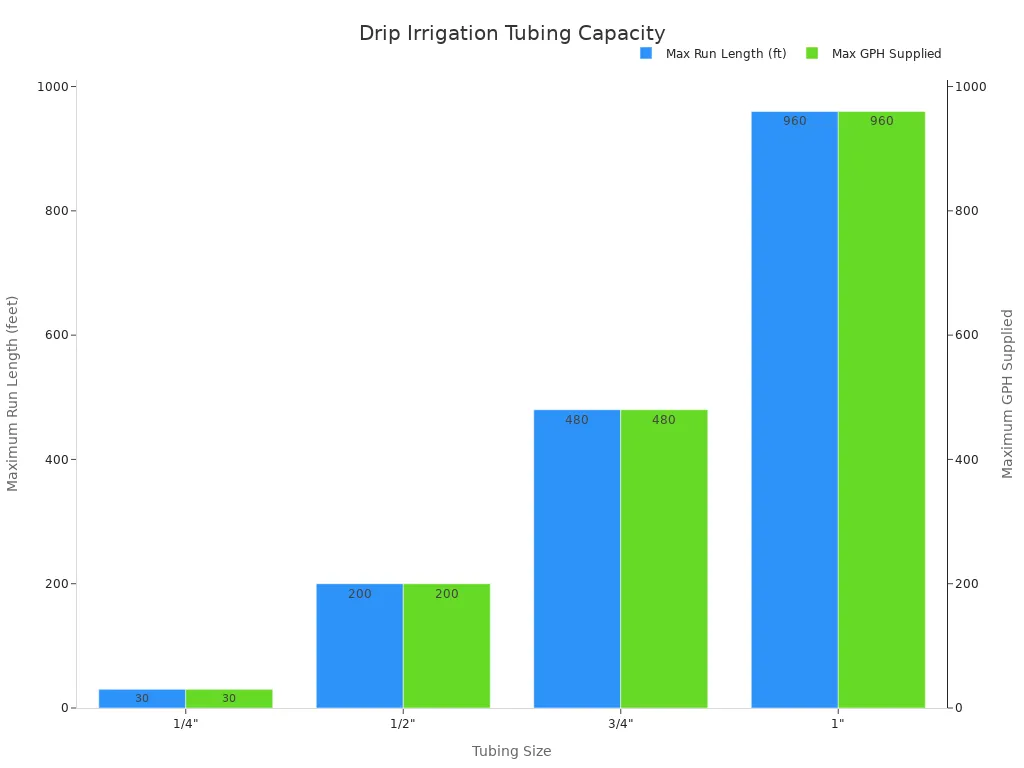
Standard poly tubing works as the bigger mainline in drip systems. Microtubing works as the feeder line that comes off that mainline. The table below shows how size limits run length and flow capacity.
Tubing Size | Maximum Run Length | Maximum GPH Supplied |
|---|---|---|
1/4" | 30 feet | 30 GPH |
1/2" | 200 feet | 200 GPH |
3/4" | 480 feet | 480 GPH |
1" | 960 feet | 960 GPH |
Common Confusions
People often mix up microtubing with capillary tubing. Capillary tubing uses surface tension and gravity to move things. Microtubing uses pressure to push flow. Standard poly tubing is also different because it carries more volume at larger sizes.
Core Functional Roles
Fluid and Gas Transfer
Microtubing sends liquids and gases to a certain spot. Medical devices use it to move reagents. Analytical instruments use it to route samples. Industrial systems use it to supply air or coolant.
Flow Regulation
The narrow bore limits flow and makes pressure drop easy to predict. Emitters and drippers use this limit to control water volume at each plant. Engineers pick ID and length together to reach a target flow rate.
The Complete Guide to Microtubing: Applications Overview
Drip Irrigation Applications
Mainline and Feeder Lines
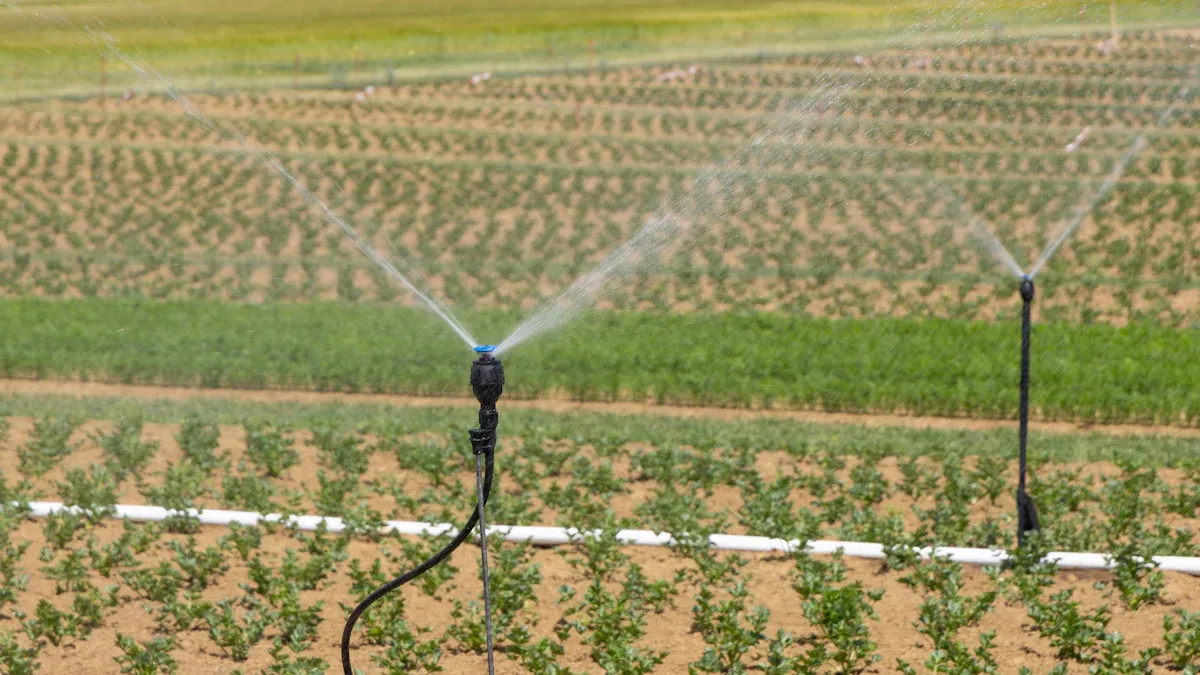
Growers use 1/4 inch micro tubing as feeder lines that branch off larger mainline tubing. The mainline carries water across a field. The feeder line then delivers that water to a specific plant or row. This two-level layout keeps pressure steady and saves material.
Polyethylene is the common material for drip irrigation tubing. It is a tough yet flexible plastic, and it comes mostly in black. Its lifespan depends on climate. In general, the tubing can last up to 30 years. In sunny and hot climates such as Florida, it lasts about 4 to 5 years.
Emitters and Flow Control
Drip irrigation emitters, also called drippers, control the volume and flow rate of water from tubing to plants. Each emitter releases a set amount of water at a set pressure. This design prevents overwatering and directs water to the root zone.
When plant water requirements are uncertain, tighter emitter spacing helps. Adjusting spacing by soil type compensates for differences in lateral water movement.
Soil Type | Recommended Emitter Spacing for 1/4-inch Tubing |
|---|---|
Sand | 12 inches |
Loam | 18 inches |
Clay | 24 inches |
Laser-drilled 1/4-inch emitter tubing is manufactured with holes spaced every 9 inches. It delivers approximately 2.3 gallons per hour per foot at 20 psi. This fixed spacing suits closely spaced plants when precise water requirements are not known.
Medical and Laboratory Applications
Analytical Instrumentation and HPLC
Lab teams must select tubing materials based on durability and chemical resistance. In HPLC systems, the tubing must handle aggressive solvents without shedding contaminants.
PEEK Tubing HPLC systems require tubing with high purity and excellent chemical resistance. PEEK tubing has become the preferred material for HPLC and UHPLC instruments, chromatography columns, sample loops, solvent delivery systems, injection valves, flow restrictors, and bio-pharmaceutical analysis. Compared with stainless steel tubing, PEEK tubing eliminates metal ion contamination and improves compatibility with aggressive solvents and biological samples. PEEK tubing offers outstanding chemical resistance and excellent solvent compatibility, making it suitable for HPLC and analytical instruments.
Pharmaceutical and Biotech Uses
Pharmaceutical and biotech processes demand clean tubing that survives repeated sterilization. PTFE microtubing meets this need through two common methods:
ETO (ethylene oxide) sterilization — Zeus PTFE microtubing is stated to be compatible with ETO sterilization.
Autoclaving (steam sterilization) — Zeus PTFE microtubing is stated to be compatible with autoclaving, supported by its high temperature tolerance and ability to survive autoclave cycles.
PTFE withstands temperatures from cryogenic levels up to 260°C (500°F). This property underpins its autoclave compatibility.
Industrial and Hobbyist Applications
Automation and Pneumatics
Factory automation systems use microtubing to route air, coolant, and hydraulic fluid. The narrow bore allows precise actuator control and fits into tight machine spaces. Pneumatic circuits benefit from the fast response that small internal volumes provide.
DIY and Prototyping
Hobbyists and engineers use microtubing for prototypes, aquariums, and small-scale fluid projects. The tubing is easy to cut, route, and connect with push-to-connect fittings. Low cost and wide availability make it a practical choice for testing a design before scaling up.
Microtubing Materials

The material you pick affects every other choice in a microtubing project. The right polymer or metal sets chemical resistance, temperature range, pressure capacity, and cost. This section covers the main options and compares how they perform.
Polymer Tubing Options
Poly tubing is a common material for drip irrigation. It comes in different sizes and specifications. Growers pick poly tubing because it resists UV damage, handles outdoor conditions, and connects easily with standard fittings.
PTFE and PFA
PTFE microtubing is almost completely inert to chemical attack. This makes it the top choice for aggressive solvents and reactive fluids. PTFE also handles extreme temperatures. It withstands temperatures from cryogenic levels up to 260°C (500°F). This range supports autoclave sterilization and harsh industrial processes.
PFA microtubing is more flexible than PTFE. Engineers choose PFA when the tubing must bend around tight corners or fit into compact spaces. PFA keeps most of the chemical resistance of PTFE while adding pliability. Both materials serve pharmaceutical, biotech, and analytical applications.
PEEK
PEEK tubing comes in different sizes and is used in HPLC applications. Color codes show the different sizes. This system helps technicians grab the right tube quickly. PEEK tubing eliminates metal ion contamination and improves compatibility with aggressive solvents and biological samples. It offers outstanding chemical resistance and excellent solvent compatibility. These traits make PEEK suitable for HPLC and analytical instruments.
Polyethylene and LDPE
Drip irrigation systems use several tubing materials. Common options include PVC, Blu Lock, IPS, and LDPE. LDPE is the most common. Low-density polyethylene balances cost, flexibility, and durability. It resists cracking and handles typical water pressures in agricultural settings. LDPE also connects with barbed and push-to-connect fittings.
Metal and Specialty Tubing
Stainless Steel
Stainless steel microtubing handles high pressure and high temperature. It resists corrosion in many environments. Labs and factories use stainless steel when polymer tubing cannot meet pressure or thermal demands. The trade-off is stiffness. Stainless steel does not bend easily and requires special fittings.
Glass and Fused Silica
Glass and fused silica microtubing serve analytical instruments. These materials offer excellent optical clarity and chemical inertness. Fused silica handles high temperatures and resists most solvents. The main drawback is fragility. Glass tubing breaks under impact or bending stress.
Material Comparison
Chemical Compatibility
Chemical compatibility decides which material survives contact with a given fluid. PTFE and PFA resist nearly all chemicals. PEEK handles aggressive solvents and biological samples. LDPE works well with water and mild chemicals. Stainless steel resists corrosion but reacts with some acids. Glass and fused silica resist most solvents but break under physical stress.
Temperature and Pressure Limits
Temperature and pressure limits vary widely by material. The table below summarizes key properties.
Material | Chemical Compatibility | Temperature Limit | Pressure Limit |
|---|---|---|---|
PTFE | Almost completely inert | Up to 260°C (500°F) | Moderate |
PFA | High, similar to PTFE | High | Moderate |
PEEK | Outstanding solvent resistance | High | High |
LDPE | Good for water and mild chemicals | Moderate | Moderate |
Stainless Steel | Corrosion resistant | Very high | Very high |
Glass / Fused Silica | Excellent inertness | High | Low |
PTFE and PFA share similar chemical resistance. PFA adds flexibility. PEEK provides the best balance of chemical resistance and pressure capacity among polymers. LDPE offers a low-cost option for water-based systems. Stainless steel wins on pressure and temperature. Glass and fused silica excel in analytical work where purity matters most.
Material selection also affects fitting choice. PTFE and PFA work with compression fittings. PEEK uses specialized HPLC fittings. LDPE connects with barbed inserts. Stainless steel requires metal ferrules. Glass needs special connectors to avoid cracking.
Each material serves a distinct role. The application, fluid type, temperature, and pressure requirements point to the right choice. The next section covers how to match these factors to a specific project.
Selection Criteria
Sizing and Dimensions
ID, OD, and Wall Thickness
The inside diameter of the tubing indicates how much water, or water pressure, can pass through it at any given moment. A larger inner diameter allows the tubing to handle more water pressure. The ID is the width of the interior water channel, and it determines how much water can flow through the pipe. It affects water flow rate, pressure capacity, and overall system performance. The OD, by contrast, governs how the tube mates with fittings and ports. Wall thickness follows from the two: it is half the difference between OD and ID. A thicker wall raises burst strength and resists kinking, while a thinner wall saves space and bends more easily.
Medical and analytical work demands far tighter control. Drawn seamless tubing typically holds OD to plus or minus 0.01 mm to 0.02 mm, depending on diameter and drawing-die capability. For very small bores, ID tolerance runs to plus or minus 1 percent of nominal above 0.51 mm, and to plus or minus 0.005 mm below that threshold. Wall thickness tolerance sits at plus or minus 0.006 mm for walls above 0.025 mm. Cut length for pieces under 100 mm holds to plus or minus 0.10 mm, and lengths from 100 to 500 mm hold to plus or minus 0.20 mm. Tighter tolerances require secondary grinding or laser cutting.
Fittings and Connections
Fitting compatibility starts with the OD. DIG's 1/4-inch polyethylene micro tubing has a nominal size of 0.170-inch inner diameter by 0.250-inch outer diameter. It works with DIG's and other manufacturers' 1/4-inch barbed fittings, and it is interchangeable with other brands of the same outer diameter. A buyer should follow a few simple rules:
1/4-inch micro tubing connects with barbed fittings only.
Fittings must match the tubing diameter exactly.
A DripWorks 1/4-inch micro fitting is guaranteed to fit DripWorks 1/4-inch micro tubing.
The same matching rule applies across the brand's drip tubing, drip tape, and fittings.
Pressure and Temperature Ratings
Burst vs. Working Pressure
Burst pressure marks the point of failure. Working pressure marks the safe operating ceiling, and it sits well below burst. Engineers should size the system so normal operation stays under the working rating, with margin for surges. A thicker wall raises both figures, so wall thickness is a pressure decision as much as a dimensional one.
Thermal Effects
Heat softens polymer tubing and lowers its pressure capacity. Cold makes it brittle and prone to cracking. PTFE withstands temperatures from cryogenic levels up to 260°C (500°F), which supports autoclave sterilization. LDPE handles moderate temperatures only. Stainless steel and glass tolerate far higher heat. A system that cycles through wide temperature swings stresses fittings and tube alike, so the designer should confirm the rating at the extreme, not the average.
Chemical Compatibility and Flow
Matching Material to Media
The fluid decides the material. PTFE and PFA resist nearly all chemicals. PEEK handles aggressive solvents and biological samples. LDPE suits water and mild chemicals. Stainless steel resists corrosion but reacts with some acids. Glass and fused silica resist most solvents but break under physical stress. A mismatch shows up as swelling, cracking, or contamination of the process stream.
Flow Rate and Pressure Drop
The ID sets both flow capacity and friction loss. A larger inner diameter reduces pressure drop at the same flow rate. The Hazen-Williams relation for lateral head loss makes this plain:
Hfl = F × (L/100) × [ { k × (Q/C)^1.85 } / D^4.871 ]
where Hfl is head loss in feet, L is lateral length in feet, F is the multiple outlet coefficient, Q is flow rate in gpm, D is inside diameter in inches, k is 1,045 for Q in gpm and D in inches, and C is the friction coefficient (150 for PVC or PE pipe, 130 for pipes under 2 inches).
Pressure loss is inversely related to diameter raised to the 4.871 power, so a small bore change moves friction loss a great deal. The table below shows the effect in practice.
Nominal Size | Flow Rate (GPH) | Friction Loss (PSI/100 ft) |
|---|---|---|
⅛" (0.125" × 0.185") | 3 | 5.9 |
⅛" (0.125" × 0.185") | 6 | 19.7 |
⅛" (0.125" × 0.185") | 9 | 41.5 |
¼" (0.170" × 0.250") | 3 | 1.3 |
¼" (0.170" × 0.250") | 6 | 4.3 |
¼" (0.170" × 0.250") | 9 | 9.1 |
¼" (0.170" × 0.250") | 12 | 15.6 |
¼" (0.170" × 0.250") | 15 | 23.9 |
¼" (0.170" × 0.250") | 18 | 33.0 |
¼" (0.170" × 0.250") | 21 | 44.3 |
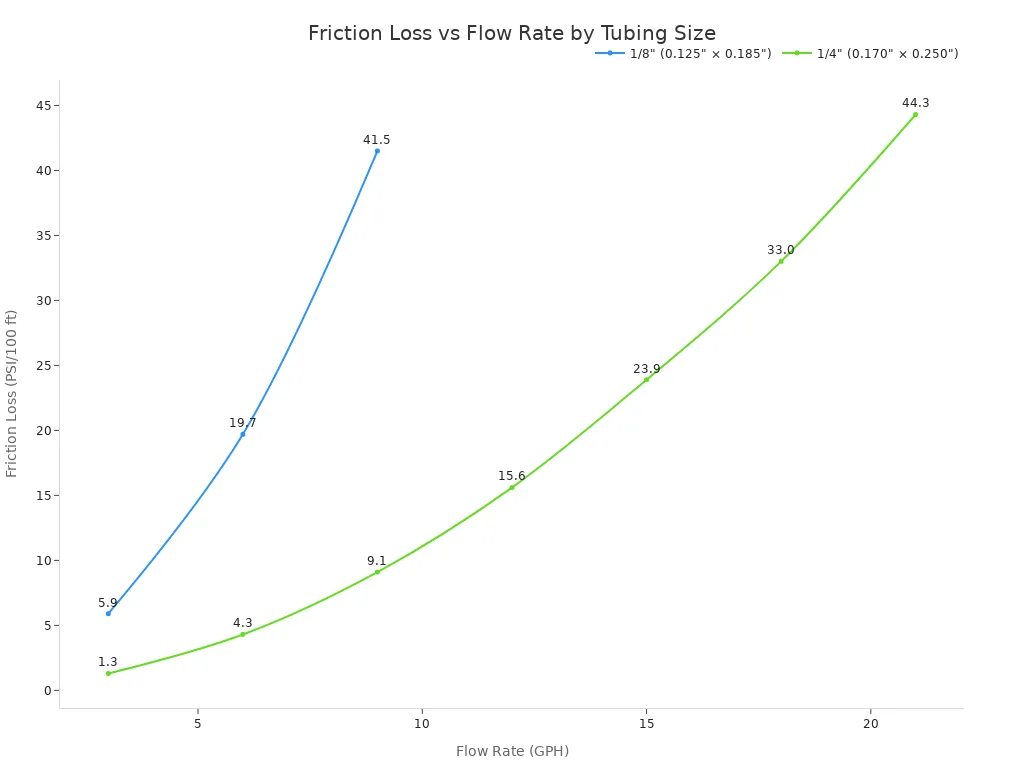
For a given flow rate, the smaller nominal size produces higher friction loss and pressure drop. When selecting poly tubing for drip irrigation, the buyer should match the size and specifications to the system's requirements. General guidelines help: keep laterals within the run-length limit for the chosen size, use tighter emitter spacing when plant water needs are uncertain, and confirm that the OD matches the available fittings before ordering.
Supplier and Quality Considerations
Evaluating Suppliers
Custom Sizing and Services
A good supplier gives you more than just a list of products. Many projects need a certain inner diameter, a specific cut length, or a shape that is not round. Suppliers who make tubing themselves can keep tight tolerances and change sizes to fit your design. Buyers should ask if the supplier cuts, coils, or cleans tubing before shipping. These services save time and lower the chance of damage during handling.
Certifications and Traceability
Certifications set qualified suppliers apart from the rest. Medical and pharmaceutical buyers use ISO 13485 as a main filter for their supply base. Compounders must have this certification along with proven cleaning methods and mother-batch traceability. USP Class VI biocompatibility testing matters for FDA clearance, as do USP <467> particulate testing and extractable limits. Device makers spend 18–24 months on FDA submission dossiers, which locks in their procurement choices. Bundled FDA and EU biocompatibility packages lower qualification risk, and GMP documentation builds customer loyalty and multi-year supply agreements.
Certification / Requirement | Relevance to Microtubing Suppliers |
|---|---|
ISO 13485 | Key filter for the supply base; requires validated cleaning and mother-batch traceability |
USP Class VI | Biocompatibility testing for FDA clearance, with USP <467> particulate testing |
FDA master file | 18–24 month submission dossiers create procurement lock-in |
GMP documentation | Reduces qualification risk and supports multi-year supply agreements |
Quality Control Standards
Dimensional Tolerances
Tolerance control decides whether tubing fits a fitting or a port. A supplier with a written inspection process measures ID, OD, and wall thickness on every lot. Buyers should ask for the tolerance range in writing before they place an order. A supplier who cannot state its tolerance limits cannot promise a fit that stays the same.
Cleanroom and Sterilization
Cleanroom production keeps particles off the tubing surface. This matters for HPLC, pharmaceutical, and biotech work. Sterilization methods also differ. PTFE microtubing works with ETO sterilization and with autoclaving, thanks to its high temperature tolerance. Buyers should make sure the supplier's packaging keeps the tubing clean through shipping and storage.
Cost vs. Performance
Premium Material Trade-Offs
PTFE, PFA, and PEEK cost more than LDPE. That higher price buys chemical resistance, higher temperature limits, and better pressure capacity. A water-based irrigation system almost never needs that level of performance. An HPLC system almost always does. Buyers should match the material to the media and the operating conditions, not to the lowest price.
Volume and Lead Times
Lead times change with the type of order. Stock tubing ships in 3–5 business days. Custom projects take 2–4 weeks on average. Custom fabricated capillary tubes, including non-circular cross-sections or tight-tolerance IDs, take 7–15 business days depending on complexity and volume. Sample shipments usually arrive in 3 working days, and production runs take 7–20 working days. Buyers should plan around these windows and confirm availability before they commit to a project schedule.
A Practical Selection Workflow
Step-by-Step Decision Process
Define Requirements
A selection workflow starts with clear requirements. The buyer must figure out which fluid moves through the tubing. Flow rate, operating pressure, and temperature range all matter. The environment matters too. Outdoor systems need UV resistance. Laboratory systems need chemical resistance and purity. Writing down these requirements stops costly mistakes.
Physical limits also shrink the choices. Microtubing fits into small spaces. But a 1/4-inch line cannot run longer than 30 feet. Sharper bends kink tubing with thin walls. Physical limits guide the selection from the start.
Narrow Materials
Requirements point the buyer to a material group. Water-based outdoor systems suit LDPE. Strong solvents demand PTFE or PFA. HPLC instruments require PEEK. High-pressure circuits need stainless steel. The chemical compatibility table shows which fluids each material handles.
Temperature and pressure limits shrink the list even more. PTFE withstands temperatures from cryogenic levels up to 260°C. LDPE handles moderate temperatures only. Stainless steel supports very high heat. The buyer matches the material's rating to the worst-case condition.
Confirm Sizing and Ratings
The ID controls flow capacity. A larger ID lowers pressure drop at the same flow rate. The OD controls fitting compatibility. Standard 1/4-inch polyethylene tubing has a 0.250-inch OD.
Pressure ratings come next. Working pressure sits below burst pressure. Temperature affects pressure capacity. Heat softens polymer tubing. Cold makes it brittle. The rating at the extreme operating temperature governs the safe working limit.
Common Mistakes to Avoid
Temperature Cycling Oversights
Some systems cycle between hot and cold. Each cycle stresses the tubing. Heat lowers pressure capacity. Cold makes polymers brittle. PTFE handles wide temperature swings. LDPE may fail after repeated cycles.
Fittings also expand with heat. A fitting designed for room temperature may loosen at high temperature. The buyer checks the fitting's temperature range, not just the tubing's range.
Fitting Mismatches
OD mismatch causes leaks or tube blow-off. 1/4-inch micro tubing connects with barbed fittings only. The fitting must match the tubing OD exactly.
Different materials need different connectors. PTFE works with compression fittings. PEEK uses specialized HPLC fittings. LDPE connects with barbed inserts. Stainless steel requires metal ferrules. Using the wrong connector damages the tube.
Testing and Validation
Prototype Evaluation
A test loop reveals problems before full deployment. The builder puts together a short section with the chosen tubing, fittings, and fluid. The test measures flow rate at expected pressure. The builder checks for leaks and kinking.
The test should run for a long period. Chemical attack may take hours or days to show. Temperature cycling speeds up the process. A week-long test at worst-case conditions catches issues that a quick bench test misses.
Documentation for Compliance
Medical and analytical applications require written proof. ISO 13485 confirms a quality management system. USP Class VI confirms biocompatibility. FDA master files support regulatory submissions.
The buyer should request lot traceability and test reports. GMP documentation records manufacturing conditions. These documents lower qualification risk. A supplier without documentation cannot support regulated applications.
The Complete Guide to Microtubing shows that picking the right tubing means matching the application, material, size, pressure and temperature ratings, chemical compatibility, and supplier quality. These choices prevent failures and cut down on downtime. Readers should follow the selection workflow and talk to suppliers with specific data.
The microtubing market keeps growing. This growth comes from pharmaceutical and semiconductor demand. Artificial intelligence now allows more precise control during manufacturing. Biomaterials support precision medicine. Sustainability drives greener production through methods like friction stir extrusion. Microtubing plays a growing role in precision industries.
FAQ
What size counts as microtubing?
Microtubing is usually 1/4 inch or smaller in outer diameter. In drip irrigation, people often mean 1/4 inch tubing when they say this. This size group follows different design rules than bigger pipe. That is because precision and flow control matter more at small sizes.
How long can a 1/4 inch microtubing run?
A 1/4 inch line cannot be longer than 30 feet. It also cannot supply more than 30 GPH. These limits keep pressure steady and stop flow loss at the end. Bigger tubing sizes allow longer runs and higher flow.
Which material works best for HPLC?
PEEK tubing is the top choice for HPLC and UHPLC instruments. It stops metal ion contamination and handles harsh solvents well. Color codes on PEEK tubing show different sizes. This helps technicians pick the right tube fast.
Can PTFE microtubing survive sterilization?
Yes. PTFE microtubing works with ETO sterilization and autoclaving. It handles temperatures from very cold levels up to 260°C (500°F). This high heat tolerance supports repeated autoclave cycles without breaking down the tubing.
What happens if the tubing OD does not match the fitting?
An OD mismatch causes leaks or tube blow-off. A 1/4 inch micro tubing connects with barbed fittings only. The fitting must match the tubing diameter exactly. Different materials also need different connectors. PTFE uses compression fittings, and stainless steel needs metal ferrules.
How does inner diameter affect flow?
A larger inner diameter lowers pressure drop at the same flow rate. Pressure loss is inversely related to diameter raised to the 4.871 power. A small bore change moves friction loss a great deal. So sizing the ID correctly matters for system performance.
What certifications should a supplier hold?
Medical and pharmaceutical buyers use ISO 13485 as a main filter. USP Class VI confirms biocompatibility for FDA clearance. GMP documentation records manufacturing conditions. These certifications lower qualification risk and support regulated applications.
How long do custom microtubing orders take?
Stock tubing ships in 3 to 5 business days. Custom projects take 2 to 4 weeks on average. Custom fabricated capillary tubes take 7 to 15 business days depending on complexity. Sample shipments usually arrive in 3 working days.
The Complete Guide to Microtubing answers these common questions to help buyers make smart decisions.
See Also
A Complete Step-By-Step Manual For Selecting Proper Nitinol Tubing
Step-By-Step Instructions For Manufacturing Nitinol Microtubing Used In Neurovascular Procedures
A Detailed Step-By-Step Handbook For Producing Microcatheters
The Definitive Guide To Nitinol Parts And Their Production Methods
A Guide For Selecting The Finest FEP Tubing For Medical Equipment

© Copyright 2024 My First Blog - All Rights Reserved.