What Is 2 1/2 Inch 2:1 Heat Shrink Tubing and How Does It Work

2 1/2 inch 2:1 heat shrink tubing is a single-wall polyolefin sleeve. When you heat it, it shrinks to half its original size, or 1 1/4 inches. The 2:1 ratio means the tube's diameter gets cut in half. Heat wakes up the memory of the cross-linked polymer. Then the material squeezes tight around big cables or bundles. You use this tubing for electrical insulation, wire bundling, strain relief, and protection from rubbing. This product shows up in The Complete Guide to 2:1 2-1/2 Inch Heat Shrink Tubing: Applications. The shrink ratio always stays at 2:1, so the final size is always half the starting size. What is 2:1 single wall heat shrink? This ratio explains how the tubing shrinks.
Key Takeaways
The 2:1 ratio shrinks the tubing to half its original diameter. Use this rule to pick the right size for your cables.
Measure both the widest and thinnest parts of your wire bundle. The tubing must slide over the widest part and grip the thinnest part.
This tubing insulates and protects cables from heat, cold, and abrasion. Use it for heavy duty cable splicing and battery packs.
Single-wall tubing does not stop water. For wet locations, use dual-wall adhesive-lined tubing instead.
The 2:1 ratio provides thick walls for strong protection. It works well for most general applications and costs less than 3:1 ratios.
The Complete Guide to 2:1 2-1/2 Inch Heat Shrink Tubing: Applications

This section is your practical guide to real-world uses of 2 1/2 inch 2:1 heat shrink tubing. You will see how the 2:1 ratio handles big jobs. The 2:1 ratio also makes this tubing more versatile across general applications than 3:1 tubing. A 3:1 ratio costs more and shrinks further, yet most jobs do not need that extra range. The 2:1 ratio covers common work well. The complete guide to 2:1 2-1/2 inch heat shrink tubing: applications starts with splicing.
Large Cable Splicing
You splice large power cables when you join two heavy conductors. The 2:1 ratio lets you slide the tubing over the joint. Heat then seals the connection. This 2:1 single wall polyolefin resists heat, cold, and moisture. The material has a zero halogen composition and an operating range of -45°C to +125°C. That range suits outdoor and industrial sites. The 2:1 ratio keeps the wall thick over the splice.
Typical lab data for this product family shows strong mechanical performance. These figures come from the J-321 line, not from 2 1/2 inch stock, so treat them as typical only.
Property | Test Result |
|---|---|
Tensile Strength | 2100 PSI |
Ultimate Elongation | 450% |
Heat Aging (168 hrs @ 175°C) | Elongation 175% |
Heat Shock (4 hrs @ 225°C) | No dripping, flowing, or cracking |
Low Temperature Flexibility (4 hrs @ -55°C) | No cracking |
Water Absorption | 0.3% |
Flammability | Self-extinguishing, meets UL 224 |
Industrial Harnesses and Battery Packs
Factory floors use this tubing on wire bundles that carry heavy current. The 2:1 ratio grips each bundle tight. You protect wire from rubbing against metal frames. Battery packs need the same care. The 2:1 ratio holds cells and cables in place. This single wall heat shrink adds no adhesive, so it stays thin. Thin walls fit tight spaces inside a pack. The 2:1 ratio also speeds up assembly. Workers slide on the sleeve and apply heat. The complete guide to 2:1 2-1/2 inch heat shrink tubing: applications covers both jobs. The complete guide to 2:1 2-1/2 inch heat shrink tubing: applications ends here.
Specifications of 2:1 Heat Shrink Tubing
You need to know the key specs before using this product. The heat shrink ratio, shrink temperature, and voltage rating show how the tubing works. These numbers help you pick the right product for your cable job. You match the specs to the cable size and the working conditions. The material and the 2:1 ratio team up to make a tight, insulated sleeve.
Heat Shrink Ratio and Shrink Temperature
The heat shrink ratio tells how much the tubing gets smaller. For 2:1 heat shrink tubing, the diameter shrinks to half its starting size. A 1-inch tube shrinks to 1/2 inch. A 2 1/2-inch tube shrinks to 1 1/4 inches. This 2:1 ratio applies to every size in the product line. The heat shrink ratio helps you decide on size. You measure the largest part of the cable bundle. You measure the smallest part of the cable bundle. The supplied diameter must fit over the largest part. The recovered diameter must grip the smallest part. The heat shrink ratio makes this math easy.
The shrink temperature starts the tubing's shrinking process. Standard polyolefin heat shrink tubing starts to shrink at about 70°C (158°F). Full shrinking happens at about 110°C (230°F). You apply heat evenly around the tube. A heat gun with a diffuser nozzle works best. You keep the heat moving across the surface. You avoid holding it in one spot for too long. The cross-linked polymer remembers its original shape. It contracts smoothly around the cable. The working temperature range of the material is between -45°C and +125°C. This range covers cold outdoor spots and warm industrial floors. The heat shrink ratio does not change the temperature resistance. A 2:1 ratio tube and a 3:1 ratio tube have the same temperature limits. The ratio only changes how much it shrinks.
The heat shrink ratio also changes the final wall thickness. A 2:1 ratio tube starts with a thicker wall than a 3:1 ratio tube of the same starting size. After shrinking, the 2:1 tube keeps more material around the cable. This extra wall thickness gives better mechanical protection. It also makes the insulation stronger. The heat shrink ratio matters for both fit and protection. You pick the 2:1 ratio when you need a strong, long-lasting sleeve.
2:1 Heat Shrink Ratio and Voltage Rating
The 2:1 heat shrink ratio is directly linked to the voltage rating. The voltage rating tells you the highest voltage the tubing can insulate. Standard single-wall polyolefin heat shrink tubing has a 600-volt rating. This rating comes from testing under UL 224. UL 224 is the North American safety standard for heat-shrinkable tubing. The test uses high voltage between the wire and the outside of the tube. The material must not break down or leak current. The 2:1 heat shrink ratio helps keep the wall thickness needed for this rating.
The ratio makes sure there is a minimum insulation layer after shrinking. When the tubing shrinks, the wall thickness gets smaller in the same way. For a 2:1 ratio, the wall thickness after shrinking stays at about half the original wall. This thickness stops electrical current at 600 volts. If you oversize the tubing, the wall becomes too thin. The voltage rating drops. You must pick the right size to keep the rating. The diameter of the shrunken tube must match the cable diameter closely.
The tubing also meets flammability rules. The material passes the UL 224 VW-1 flame test. It stops burning within a short time. The zero halogen blend cuts down on toxic smoke in a fire. You also get RoHS compliance. That means no banned hazardous substances. The 2:1 ratio works with these standards to give safe insulation. Always check the maker's data sheet for exact voltage ratings for your specific product.
Sizing Heat Shrink Tubing for Large Cables
Correct sizing matters because a 2:1 ratio will shrink up to half of the original diameter. Pick the wrong size, and the sleeve either won't slide over your cable or won't grip it tight after heating. The heat shrink ratio controls this behavior, so you must match the tubing to your cable before you apply any heat.
Sizing Rules
Start by measuring the widest point of the cable or bundle. Then measure the thinnest point. You need both numbers. The bundle's widest diameter tells you the smallest tubing that will slide on. The thinnest point tells you the largest tubing that will still grip after shrinking.
The rule is simple. Your supplied diameter must be larger than the widest point. Your recovered diameter must be smaller than the thinnest point. This is the 2:1 rule of thumb. The heat shrink ratio guarantees the tube shrinks to half its starting size, so the recovered diameter is always about half the supplied diameter.
Measure or estimate the bundle's widest diameter. The correct 2:1 tubing size has a supplied diameter comfortably above that measurement, while its recovered diameter — approximately half the supplied size — must be below the bundle's thinnest point so the sleeve shrinks down and grips. If the profile is too uneven for 2:1 tubing to satisfy both conditions, a 3:1 ratio should be used instead.
Suppose you have a wire bundle with a widest point of 20 mm and a thinnest point of 14 mm. A 2-inch tube has a supplied diameter of 50.8 mm and a recovered diameter of 25.4 mm. The supplied diameter clears the widest point. The recovered diameter is larger than 14 mm, so it won't grip. You need a smaller size. A 1-inch tube has a supplied diameter of 25.4 mm and a recovered diameter of 12.7 mm. The supplied diameter clears 20 mm. The recovered diameter of 12.7 mm is below 14 mm, so it grips. This example shows how the heat shrink ratio guides your choice.
Sizing 2:1 tubing for wire bundles with uneven profiles takes extra care. The heat shrink ratio stays fixed at 2:1, so you cannot adjust the shrink amount. You can only change the starting size. Always check both the expanded inner diameter and the recovered diameter against your measurements.
Sizing Table
This heat shrink tubing size chart shows common 2:1 sizes and their grip ranges. Use it as a starting point for your own measurements.
2:1 Supplied Size | Recovered Diameter (approx.) | Grips Bundle Diameters | Typical Application |
|---|---|---|---|
1/4" (6.4 mm) | 3.2 mm | 3.5–5.5 mm | 2–3 × 18 AWG signal wires |
3/8" (9.5 mm) | 4.8 mm | 5.5–8.5 mm | 3–5 × 16 AWG, small looms |
1/2" (12.7 mm) | 6.4 mm | 7–11 mm | 5–8 wire harness branch |
3/4" (19.1 mm) | 9.6 mm | 11–17 mm | Control-panel bundles |
1" (25.4 mm) | 12.7 mm | 14–22 mm | Full harness sections |
1-1/2" (38 mm) | 19 mm | 21–34 mm | Cable groups, sleeved assemblies |
2" (50.8 mm) | 25.4 mm | 28–45 mm | Battery packs, large assemblies |
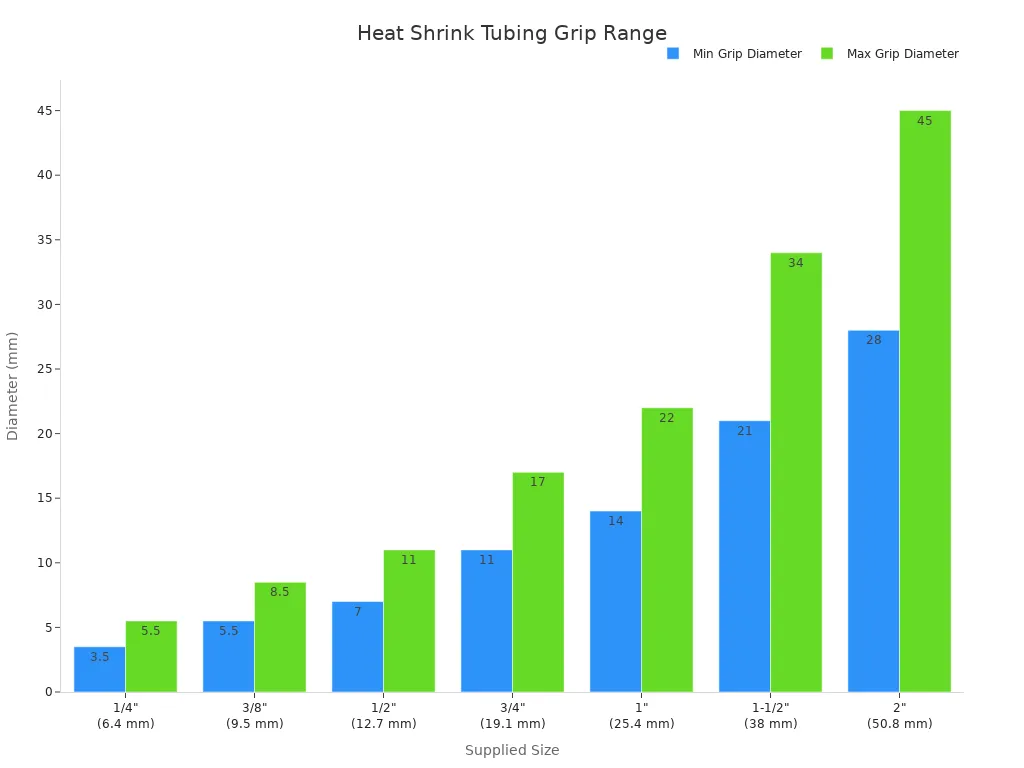
The heat shrink ratio stays at 2:1 for every row. The ratio never changes. Only the starting size changes. Match your cable measurement to the grip range, and the 2:1 heat shrink ratio does the rest.
When Not to Use 2 1/2 Inch Tubing
This 2 1/2 inch product works well in many dry places. But it is not right for every job. The heat shrink ratio limits where this product fits. Some tasks need a different kind of sleeve. You need to know when to choose another option.
Waterproofing Needs
Do not use single wall heat shrink tubing in wet locations. The 2:1 single wall heat shrink depends on radial compression. There is no adhesive inside the tube. Small gaps can stay between the sleeve and the wire. Water can leak through these gaps. The heat shrink ratio does not make a seal. It only shrinks the tube around the wire. This single wall heat shrink does not stop moisture for long.
What should you use instead? You need adhesive-lined polyolefin tubing. This dual wall product has hot-melt adhesive inside. When you heat it, the adhesive flows into every gap. The bond keeps out water, dust, and chemicals. The heat shrink ratio stays the same. But the adhesive adds a seal. This tubing gives a weather-tight barrier. The table below shows the differences.
Specification | Single Wall Tubing | Dual Wall Tubing |
|---|---|---|
Construction | Cross-linked polyolefin | Cross-linked polyolefin with hot-melt adhesive |
Waterproof Protection | No | Yes |
Adhesive Lining | None | Integrated inner adhesive |
Moisture Resistance | Moderate | Excellent |
Corrosion Protection | Limited | High |
Chemical Resistance | Good | Excellent |
Typical Applications | Wire insulation, cable bundling, electronics | Automotive, marine, underground, outdoor wiring |
Choose a dual wall product for any job where water can reach the connection. The heat shrink ratio on dual wall products works the same way. But the adhesive-lined polyolefin saves you from failure later. The 2:1 ratio still applies here. But you get a seal that keeps out water.
High-Flex Needs
The heat shrink ratio also limits flexibility. The single wall product gets stiff after shrinking. The material does not bend well in tight spaces. A wire that moves needs a more flexible sleeve. The heat shrink ratio gives a certain wall thickness. A thick wall resists bending. You get good protection but poor flexibility. The diameter of the tube affects this too. A large diameter makes bending harder.
When flexibility matters, the heat shrink ratio is not the only factor. What should you use instead? Look for thin wall or high-flex heat shrink tubing. These products use different materials. They bend more easily. The heat shrink ratio may be the same. But the material formula changes. You can also use braided sleeving for very flexible needs. The heat shrink ratio helps you pick the right size. But it does not tell you about flexibility. Check the product data sheet for bend radius. If the cable moves often, choose a flexible grade. The right size matters for fit. But the heat shrink ratio alone cannot solve a flex problem.
2 1/2 inch 2:1 heat shrink tubing is a single-wall polyolefin sleeve for large cables. Heat shrinks it to 1 1/4 inches. The heat shrink ratio stays at 2:1. The final diameter halves. The heat shrink ratio drives sizing. Your supplied size must clear the widest point. The recovered value must sit below the thinnest point. The heat shrink ratio simplifies that math. Choose dual wall adhesive lined tubing for waterproofing. The heat shrink ratio there works the same way. The 2:1 ratio beats the 3:1 ratio. The heat shrink ratio covers common jobs. The 2:1 ratio wins for general work. Trust the ratio, check the ratio, and apply heat evenly.
FAQ
What does the 2:1 ratio mean on this tubing?
The ratio tells you how much the tubing shrinks. A 2:1 ratio cuts the diameter in half. Your 2 1/2 inch tube becomes 1 1/4 inches after heating. This ratio stays the same for every size in the product line.
How do you shrink 2 1/2 inch tubing?
You apply heat evenly with a heat gun. The material starts to shrink near 70°C and finishes near 110°C. The cross-linked polymer remembers its shape. The ratio then pulls the sleeve tight around your cable.
What cable sizes fit 2 1/2 inch tubing?
Your supplied diameter must clear the widest point of the bundle. The recovered diameter must sit below the thinnest point. This ratio rule keeps the sleeve tight. Measure both points before you pick a size.
Can you use this tubing outdoors?
Yes, in dry and protected spots. The material handles -45°C to +125°C. But the ratio alone cannot stop water. Choose dual wall adhesive lined tubing for wet locations. The adhesive seals gaps that single wall tubing leaves open.
Does the ratio affect the voltage rating?
Yes. Single wall polyolefin carries a 600-volt rating under UL 224. The ratio keeps enough wall thickness after shrinking. Oversizing thins the wall and lowers that rating. Match the size to your cable to hold the rating.
See Also
How Heat Shrink Tubing Insulates Electrical Wires And Its Common Uses
Medical Grade Versus Industrial Grade Heat Shrink Tubing Explained Clearly
A Step By Step Guide For Choosing Correct Heat Shrink Tubing Size
Essential Facts About PET Heat Shrink Tubing Used In Electronics
FEP Autoclavable Heat Shrink Tubing Explained In A Simple Way

© Copyright 2024 My First Blog - All Rights Reserved.