What Are the Shrink Ratios of PET Heat Shrinkable Tubing

You often see PET heat shrinkable tubing in 2:1 or 3:1 shrink ratios. This number tells you how much the tubing can shrink compared to its original size. For example, a 2:1 ratio means the tubing can shrink to half its width. You need to know this because the right ratio helps you cover wires or parts tightly. PET Heat Shrinkable Tubing Properties: Understanding Shrink Ratios and Temperature Requirements helps you pick the best option for your project.
Key Takeaways
Understand shrink ratios: A 2:1 ratio means the tubing shrinks to half its diameter, while a 3:1 ratio shrinks to one-third. Choose based on your project's needs.
Select the right temperature: PET tubing starts shrinking at 70°C (158°F) and works best around 150°C (302°F). Follow these guidelines for effective results.
Consider application requirements: Use 2:1 tubing for standard wire insulation and 3:1 for irregular shapes. This ensures a snug fit and better protection.
Measure carefully: Always choose tubing with an expanded diameter larger than your object. The recovered diameter should be smaller than the smallest part to cover.
Follow best practices: Use about 75% of the tubing's shrink potential for optimal fit. Store tubing properly and avoid overheating during the shrinking process.
PET Heat Shrinkable Tubing Properties: Understanding Shrink Ratios and Temperature Requirements
What Is a Shrink Ratio
You need to know what a shrink ratio means before you choose PET heat shrinkable tubing. The shrink ratio tells you how much the tubing can shrink when you apply heat. For example, a 2:1 shrink ratio means the tubing will shrink to half its original diameter. A 3:1 shrink ratio means it will shrink to one-third of its starting size. You can use a higher shrink ratio to cover bigger objects or wires with different sizes. This helps you get a tight fit and better protection.
Tip: A higher shrink ratio gives you more flexibility for different shapes and sizes.
How Shrink Ratios Are Measured
You can measure the shrink ratio of PET tubing by comparing its size before and after heating. In labs, people use special methods to test this. They often put a 100mm piece of tubing in boiling water or a drying oven, then measure the width with a digital caliper. Here is a table that shows common ways to measure shrink ratios:
Method Type | Procedure |
|---|---|
Lateral Shrinkable Ratio | 1. Immerse a 100mm plastic tube in boiling water (98±2℃) for 30 seconds. |
Longitudinal Shrinkable Ratio | Same as above, but measure the length. |
High Temperature Longitudinal Ratio | 1. Place a 100mm sample in a drying oven at 180±2℃ for 15 minutes. |
Shrink Temperature for PET Tubing
You need to heat PET tubing to a certain temperature to make it shrink. PET heat shrinkable tubing properties: understanding shrink ratios and temperature requirements helps you know the right temperature range. PET tubing usually starts to shrink at 70°C (158°F) and can go up to 190°C (374°F). The most common shrinking temperature is about 150°C (302°F). Here is a table that shows the shrinking temperatures for PET and other materials:
Material | Shrink Temperature (°C) | Shrink Temperature (°F) |
|---|---|---|
PET | 60 | 140 |
PVC | 100 | 212 |
Polyolefin | 120 | 229 |
PTFE | 340 | 644 |
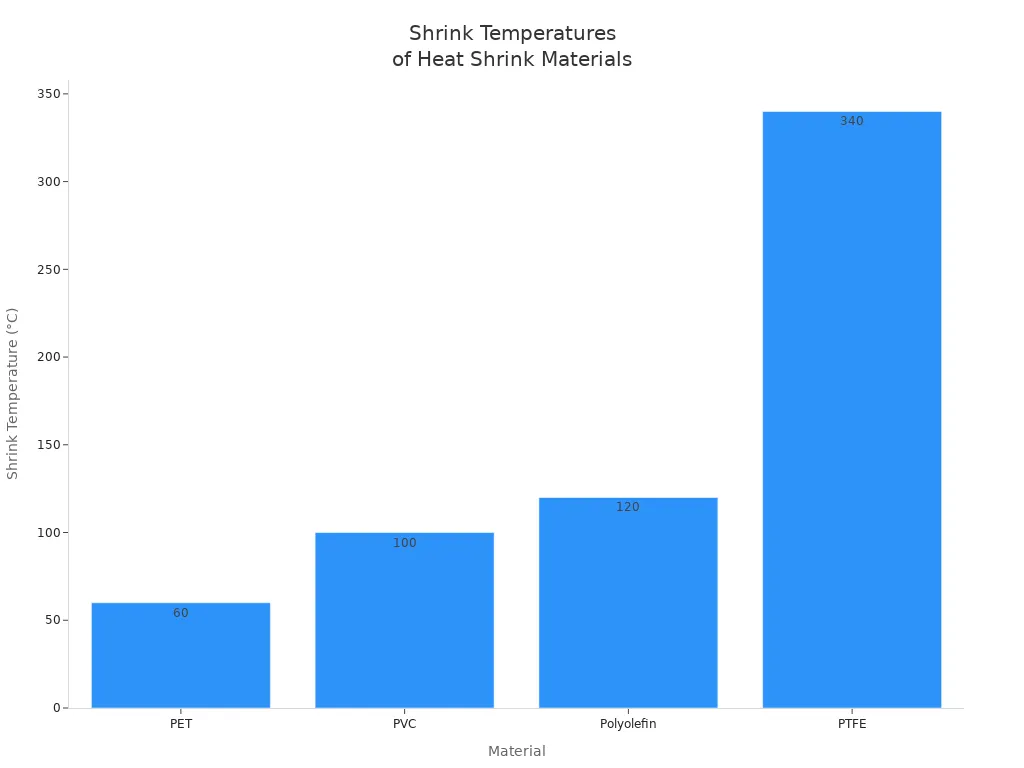
You can see that PET heat shrinkable tubing properties: understanding shrink ratios and temperature requirements make PET a good choice for projects that need lower heat.
PET Shrink Ratios Explained

When you choose PET heat shrinkable tubing, you usually see two main shrink ratios: 2:1 and 3:1. These numbers tell you how much the tubing will shrink when you apply heat. Each ratio has its own uses and benefits. Knowing the difference helps you pick the right tubing for your project.
2:1 Shrink Ratio
A 2:1 shrink ratio means the tubing will shrink to half its original diameter. This is the most common shrink ratio for PET heat shrinkable tubing. You will find it in many electrical and mechanical projects. Here are some important points about the 2:1 shrink ratio:
You can use 2:1 tubing to cover wires, cable bundles, or connectors.
It works well for jacketing wire harnesses because it resists moisture and chemicals.
You can find 2:1 tubing in both single wall and dual wall types.
Most heat shrink tubing on the market uses a 2:1 shrink ratio, so you have many size options.
Note: If you work with wires or cables that have a steady diameter, 2:1 tubing gives you a snug fit without much waste.
3:1 Shrink Ratio
A 3:1 shrink ratio means the tubing will shrink to one-third of its original diameter. This ratio gives you more flexibility when you need to cover objects with different shapes or sizes. You can use 3:1 tubing for parts that have large connectors or uneven surfaces. Here is a table that compares 2:1 and 3:1 shrink ratios:
Shrink Ratio | Coverage Range | Application |
|---|---|---|
3:1 | Accommodates diameter variations of 100% or more | Ideal for irregular shapes and minimizing inventory |
2:1 | Requires multiple sizes for wider diameter variations | Less efficient for diverse cable sizes |
You will notice that 3:1 tubing can handle bigger changes in diameter. This makes it a good choice if you want to keep fewer sizes in stock. You can use one size of 3:1 tubing for many different jobs.
Tip: 3:1 is usually the maximum shrink ratio for PET heat shrinkable tubing. If you need even more shrink, you may need to look at other materials.
When you look at PET Heat Shrinkable Tubing Properties: Understanding Shrink Ratios and Temperature Requirements, you see that both 2:1 and 3:1 ratios give you strong coverage and protection. You just need to match the ratio to your project’s needs.
What Affects Shrink Ratios
PET Material Properties
You need to understand that the material properties of PET play a big role in how much the tubing can shrink. The way the tubing is stretched, the temperature during stretching, and the alignment of the polymer chains all affect the shrink ratio. If you add fillers like talc, you can make the shrinkage more even and reduce warping. This helps the tubing keep its shape after shrinking.
Here is a table that shows how different PET characteristics affect shrink ratios:
Characteristic | Effect on Shrink Ratio |
|---|---|
Stretch Ratios | Better stretch ratios give you stronger tubing and more control over shrinkage. |
Temperature Control | Stretching at the right temperature lets you get higher shrink ratios. |
Molecular Orientation | Good alignment makes the tubing strong and less likely to shrink too much. |
Crystallization Behavior | The mix of hard and soft parts in PET changes how much the tubing will shrink. |
Tip: If you want tubing that shrinks evenly, look for products with mineral fillers.
Shrink Process and Temperature
The way you heat the PET tubing also changes the shrink ratio. The manufacturing process sets the tubing’s “memory” by using cross-linking and heating steps. When you heat the tubing, the polymer molecules move back to their original positions. If you use the right temperature, you get the best shrinkage and shape retention. Too much heat or not enough can make the tubing shrink unevenly or lose its strength.
You should always follow the recommended temperature range for PET tubing. This helps you get a tight fit and keeps the tubing strong.
Shrink Direction (MD vs. TD)
PET tubing does not shrink the same way in every direction. You will see two main directions:
Machine Direction (MD): Along the length of the tubing.
Transverse Direction (TD): Across the width of the tubing.
Here is a table that shows the difference:
Direction | Shrinkage Ratio (%) |
|---|---|
MD | 5 - 15 |
TD | 30 - 70 or higher |
The way the polymer chains line up during manufacturing changes how much the tubing shrinks in each direction. If you have balanced shrinkage in both MD and TD, you avoid defects and get better coverage.
The MD and TD shrink ratios help the tubing fit tightly around different shapes.
The orientation of the molecules during production controls how much the tubing shrinks.
Bi-axial orientation gives you balanced shrinkage, which is important for strong and neat results.
Note: Always check the MD and TD shrink ratios if you need the tubing to fit complex shapes.
How to Choose a Shrink Ratio
Application Needs
You should always start by thinking about what your project needs. The right shrink ratio depends on the size and shape of the parts you want to cover. If you need a tight fit for insulation or protection, make sure the tubing’s fully shrunk diameter is smaller than the part you want to cover. This will help you get a secure seal. A higher shrink ratio, like 3:1, works well for parts with big connectors or uneven shapes. For simple wire insulation, a 2:1 ratio is often enough.
Here is a table to help you see how different application requirements can affect your choice:
Application Requirement | Influence on Shrink Ratio Selection |
|---|---|
Dimensional consistency | Keeps tubing shape and size after shrinking |
Assembly yield | Makes the assembly process easier and more successful |
Profile smoothness | Improves the look and feel of the finished product |
Surface finish | Affects how the tubing works with other parts |
Heat exposure | Decides if the tubing can handle the heat during shrinking |
Component protection | Helps keep your parts safe from damage |
Future scale-up | Makes sure the tubing works for bigger projects later |
Fit and Coverage
Getting the right fit is key. You want the tubing to shrink tightly around your wires or parts. If the tubing is too small, it may tear. If it is too large, it may not seal well. Try to use about 75% of the tubing’s listed shrink potential for the best results. The inner diameter will get smaller as the tubing shrinks, and the wall will get thicker. If you do not shrink the tubing all the way, the wall stays thinner and more flexible.
Follow these steps for a good fit:
Choose the right size—aim for a snug fit, not too tight or loose.
Rotate the heat source for even shrinking.
Avoid overheating to keep the tubing strong.
Store tubing in a cool, dry place.
Tip: For a 2-inch tube with a 2:1 shrink ratio, plan for a final fit on surfaces that are 1.25 inches or larger.
Selection Tips
You can make your project easier by following a few simple tips:
Pick tubing with the right expanded and recovered diameters.
Use a heat gun or torch for even heating.
Watch for signs of overheating, like melting or discoloration.
Expect to use only about 75% of the shrink potential for the best fit.
Lower shrink ratios (2:1, 3:1) work well for most jobs. Use higher ratios for odd shapes or tough environments.
Note: Always check the tubing’s datasheet for exact sizes and temperature limits before you start.
You need to know the shrink ratio and temperature requirements before you choose PET heat shrinkable tubing. The table below shows the most common shrink ratios:
Shrink Ratio | Description |
|---|---|
2:1 | The tubing shrinks to half its original size. |
3:1 | The tubing shrinks to one-third of its original size. |
4:1 | The tubing shrinks to one-quarter of its original size. |
You should measure carefully, check the fit, and match the tubing to your project. If you feel unsure, always read the datasheet or ask an expert for help.
FAQ
What does a 2:1 shrink ratio mean?
A 2:1 shrink ratio means the tubing shrinks to half its original diameter when you apply heat. You can use this ratio for most standard wire insulation jobs.
Can you reuse PET heat shrinkable tubing?
You cannot reuse PET heat shrinkable tubing. Once you shrink it, the tubing keeps its new shape. You need to use a new piece for each application.
How do you measure the correct size of PET tubing?
You should measure the widest part of your object. Choose tubing with an expanded diameter larger than this size. Make sure the recovered diameter is smaller than the smallest part you want to cover.
Is PET tubing safe for outdoor use?
You can use PET heat shrinkable tubing outdoors. It resists UV light, moisture, and chemicals. This makes it a good choice for outdoor electrical and mechanical protection.
What tools do you need to shrink PET tubing?
You need a heat gun or a controlled heat source. Avoid open flames. A heat gun gives you even heat and helps prevent damage to the tubing.

© Copyright 2024 My First Blog - All Rights Reserved.