What Are Kink-Resistant Nitinol Tubes and How Do They Help in Tortuous Anatomy Procedures

A kink-resistant nitinol tube for tortuous anatomy assists doctors in navigating tricky body parts. It remains flexible in twisted or curved blood vessels. Nitinol possesses superelasticity and shape memory, which ensure that the tube does not bend or fold during movement. Physicians utilize these kink-resistant nitinol tubes to minimize complications during challenging procedures. This can prevent early stent issues or problems at the entry points in the body. Employing kink-resistant nitinol tubes enhances safety when traversing difficult pathways, ultimately leading to better outcomes for patients.
Key Takeaways
Kink-resistant nitinol tubes help doctors move through twisted blood vessels. They make it safer and lower the chance of problems during procedures.
The superelasticity and shape memory of nitinol let the tubes bend easily. They go back to their original shape. This keeps them from kinking or blocking.
These tubes are biocompatible, so they are safe to use in the body for a long time. This lowers the chance of bad reactions for patients.
Using kink-resistant nitinol tubing gives doctors better control of devices. This helps get better results and means fewer device problems in hard-to-reach areas.
Nitinol's flexibility and corrosion resistance make it a good choice for medical tools. This helps keep patients safe and helps them heal faster.
Kink-Resistant Nitinol Tubing Overview
What Is Kink-Resistant Nitinol Tubing
Kink-resistant nitinol tubing is important in medicine today. Doctors use kink-resistant nitinol tubing to guide tools through tight or twisted body parts. The tubing is made from nitinol, which is a mix of nickel and titanium. Makers use careful steps to build kink-resistant nitinol tubing. They pick pure nickel and titanium first, then melt them together. Next, they shape the metal into tubes by heating and pulling it. Seamless tube drawing makes the tubing the right size and thickness. This keeps the tubing strong and bendable. Heat treatments help the tubing remember its shape and stay stretchy. All these steps make sure kink-resistant nitinol tubing is safe for medical use.
Tip: Kink-resistant nitinol tubing is used as a nitinol tube for guidewires. This helps doctors move safely in hard-to-reach places.
Safety groups check that kink-resistant nitinol tubing follows health rules. They test for safe use in the body and look for harmful effects. Controlling nickel ion release is needed to protect patients. Tests and talks with safety groups help make sure kink-resistant nitinol tubing is safe for everyone.
Key Features and Benefits
Kink-resistant nitinol tubing has many good points for doctors. Doctors pick kink-resistant nitinol tubing because it does not bend or break easily. This keeps the inside open for samples or treatments. The tubing bends and goes back to its shape, so it moves through twists and turns. Shape memory helps kink-resistant nitinol tubing fit the body’s curves and stops slipping. Flexibility lets doctors control their tools better. The tubing does not rust, especially with special coatings. Biocompatibility means treated kink-resistant nitinol tubing does not let nickel leak, so patients stay safe. Durability means kink-resistant nitinol tubing works for a long time.
Feature | Description |
|---|---|
Kink Resistance | Kink-resistant nitinol tubing does not bend or break easily, so the inside stays open. |
Superelasticity | The tubing bends and returns to shape, so it moves well in tricky places. |
Shape Memory | Kink-resistant nitinol tubing fits the body’s curves and does not slip. |
Flexibility | The tubing bends easily, so doctors can move it better. |
Corrosion Resistance | Kink-resistant nitinol tubing does not rust, so it stays safe. |
Biocompatibility | Treated tubing does not let nickel leak, so patients are safe. |
Durability | Kink-resistant nitinol tubing lasts a long time in medical work. |
Studies show kink-resistant nitinol tubing helps patients get better. For example, nitinol tube for guidewires used in blood vessel procedures had a main success rate of 78.9% after one year. Most patients got better by at least one Rutherford–Becker category. Safety was high, with 99.2% of patients having no serious problems after 30 days.
Note: Medical grade nitinol wire is used to make kink-resistant nitinol tubing for guidewires, catheters, and other tools.
Doctors trust kink-resistant nitinol tubing and nitinol tube for guidewires because these help them work safely and well in tough places.
Nitinol Properties for Tortuous Anatomy
Superelasticity and Shape Memory
Nitinol is special because it bends and stretches a lot. It does not break when doctors use it in twisted blood vessels. Superelasticity lets nitinol tubes bend far and then go back to their shape. They can bend up to 11%. Stainless steel only bends a little, about 0.5%, and stays bent unless you fix it. Nitinol can return to its shape when it gets warm or when pressure stops. This shape memory helps doctors use nitinol tubes in curvy places.
Material | Superelasticity (%) | Notes |
|---|---|---|
Nitinol | Up to 11% | Shows strong springback |
Stainless Steel | 0.5% | Does not spring back, stays bent |
Nitinol has two phases. When it is hot, it is stiff and keeps its shape. When it is cold, it is bendy and can twist without breaking. If you heat nitinol, it goes back to its old shape. This change helps nitinol tubes move in tight spots and then return to normal.
Phase | Temperature Range | Characteristics |
|---|---|---|
Austenitic | High temperatures | Hard and keeps its shape under stress. |
Martensitic | Low temperatures | Soft and can bend a lot without breaking. |
Phase Transition | Varies | Can switch between phases and get its shape back when heated. |
Tip: Nitinol tubes with shape memory help doctors reach hard spots and then go back to their shape for safe removal.
Biocompatibility and Safety
Doctors pick nitinol because it is safe in the body. Nitinol works well with human tissues. Studies show nitinol helps cells grow. Bone cells grow well on nitinol, and not many die. Cells stick to nitinol, which means it is good for the body.
Nitinol has a titanium dioxide layer that stops rust.
Most cells are fine with nitinol, but some may react.
Using nitinol for a long time can let nickel out, which might be bad.
Nitinol is mostly safe, but doctors watch for allergies.
Safety Concern | Description |
|---|---|
Corrosion and Material Degradation | Nitinol can rust and get weak, which may cause it to break. |
Thrombotic Complications | There is a higher chance of blood clots if used with other metals. |
Hematologic Complications | Nickel-titanium alloy can hurt red blood cells or cause allergies. |
Mechanical Failure | It can break if twisted too much or used wrong, especially if bent. |
Temperature Sensitivity | Nitinol changes how it bends with temperature, which can cause problems if it gets too hot or cold. |
Doctors check for problems like rust, blood clots, or allergies. The protective layer on nitinol helps stop damage, but doctors must be careful. Nitinol is strong and safe, so it is a good choice for kink-resistant tubes in twisted body parts.
Kink-Resistant Nitinol Tube for Tortuous Anatomy
Navigating Tortuous Vessels
Doctors have trouble working in twisted blood vessels. These vessels curve and turn a lot. It is hard to move medical tools inside them. The kink-resistant nitinol tube for tortuous anatomy helps doctors reach tough places. Nitinol bends easily and goes back to its shape. This keeps the tube from folding or blocking. Kink resistance lets doctors guide tools through tight curves. They do not lose control of their devices.
Many studies show how well kink-resistant nitinol tubes work:
Kink-resistant nitinol tubing is important in vascular procedures. It helps doctors move safely in tricky blood vessels.
Research shows this tubing lowers problems like catheter herniation. This means doctors can move better and get good results.
Tests in pigs found braided nitinol stents fit vessel shapes. They keep support even in twisted areas.
Another study used flexible neural electrode arrays. Nitinol tubing helped doctors reach tiny, twisted brain vessels. There was little tissue damage.
Doctors use kink-resistant nitinol tube for tortuous anatomy in many ways. Guidewires and catheters often have nitinol cores. These tools move through twisted blood vessels. They keep the inside open and maintain lumen patency. The tube’s kink resistance means fewer device failures. Procedures are safer for patients.
Evidence Description | Details |
|---|---|
Guidewire Design | Segmented nitinol guidewires with stiffness-matched connectors for CMR catheterization. |
Mechanical Properties | Freedom from RF-induced heating in vitro and in vivo. |
Clinical Application | CMR guided cardiac catheterization performed in vivo in swine. |
Doctors also use kink-resistant nitinol tube for tortuous anatomy in ureteral procedures. These tubes help reach blocked or twisted ureters. They resist kinking and keep the pathway open for urine flow. Some stents use nitinol wire with a slippery coating. This design gives good access and lowers trauma.
Clinical Example | Description |
|---|---|
Dacron-covered ureteral MS | Placed in 9 ureters with malignant strictures; no obstructions or infections during 9 months follow-up. |
Passager self-expandable nitinol stent | High migration rate (81%) in 16 patients with malignant ureteral obstruction; poor anchoring. |
Hemobahn Endoprothesis | 37 stents inserted; migration in 3 patients (22.2%); all stents remained patent up to 24 months. |
Allium Ureteral Stent | 19 stents in 17 patients; no occlusions in 7 months; one migration at 8 months. |
Doctors pick kink-resistant nitinol tube for tortuous anatomy for better navigation. These tubes keep vessels or ureters open. They lower the risk of blockages.
Device Control and Patient Safety
Kink resistance helps doctors control their devices better. When a tube resists kinking, it moves smoothly in twisted blood vessels. Doctors can place stents, guidewires, or catheters where needed. Nitinol’s superelasticity lets the tube bend and return to shape. This stops kinking and keeps the device working well.
Doctors see fewer device failures with kink-resistant nitinol tube for tortuous anatomy. Nitinol’s flexibility lets the tube follow twisted paths. It does not lose strength. This lowers the risk of device breakdown in hard procedures. The tube’s kink resistance means fewer problems. There are less blocked pathways or broken wires.
Nitinol’s superelastic properties help the tube bend and spring back. This is important for moving in twisted blood vessels.
The tube’s flexibility stops kinking. It helps guidewires and catheters work better.
The tube can follow twisted paths without losing function. This lowers the risk of device failure.
Doctors want patients to be safe during every procedure. Kink-resistant nitinol tube for tortuous anatomy helps protect patients. The tube’s design lowers trauma and keeps the vessel open. This leads to better results and fewer problems.
Failure Mode | Cycle Range | Description |
|---|---|---|
Cyclic Phase Transformation | Below 10^5 cycles | Fatigue failure from phase changes in nitinol. |
Infrequent Fractures | 10^5 to 10^8 cycles | Fractures are rare in this range. |
Common Fatigue Fractures | Beyond 10^8 cycles | Fatigue fractures increase, affected by load and material inclusions. |
Doctors use kink-resistant nitinol tube for tortuous anatomy to lower device failure risk. They want to improve patient safety. These tubes help keep the inside open and support long-term patency. Nitinol guide wires are used in vascular and ureteral procedures. The tube’s kink resistance and nitinol’s special features help doctors move better and get good results.
Tip: Kink-resistant nitinol tube for tortuous anatomy helps doctors reach tough spots, control their devices, and keep patients safe.
Nitinol Guide Wires vs. Other Materials
Flexibility and Kink Resistance
Nitinol guide wires are very flexible. Doctors use them to move through twisted or narrow blood vessels. These wires bend a lot and go back to their shape. Super elastic nitinol guide wires can handle sharp turns. They keep the vessel open during hard procedures. This makes them good for tricky cases.
Nitinol guide wires are more flexible than stainless steel or polymer wires. Stainless steel wires can kink in tight places. Nitinol guide wires do not lose their shape. They keep the vessel open. The austenite phase in nitinol helps stop kinking. When doctors use nitinol guide wires, they stay strong and bendy. This helps doctors finish procedures with fewer problems.
Material | Flexibility Comparison |
|---|---|
Nitinol | Superior flexibility, ideal for navigating complex paths |
Stainless Steel | Less flexible, more prone to kinking |
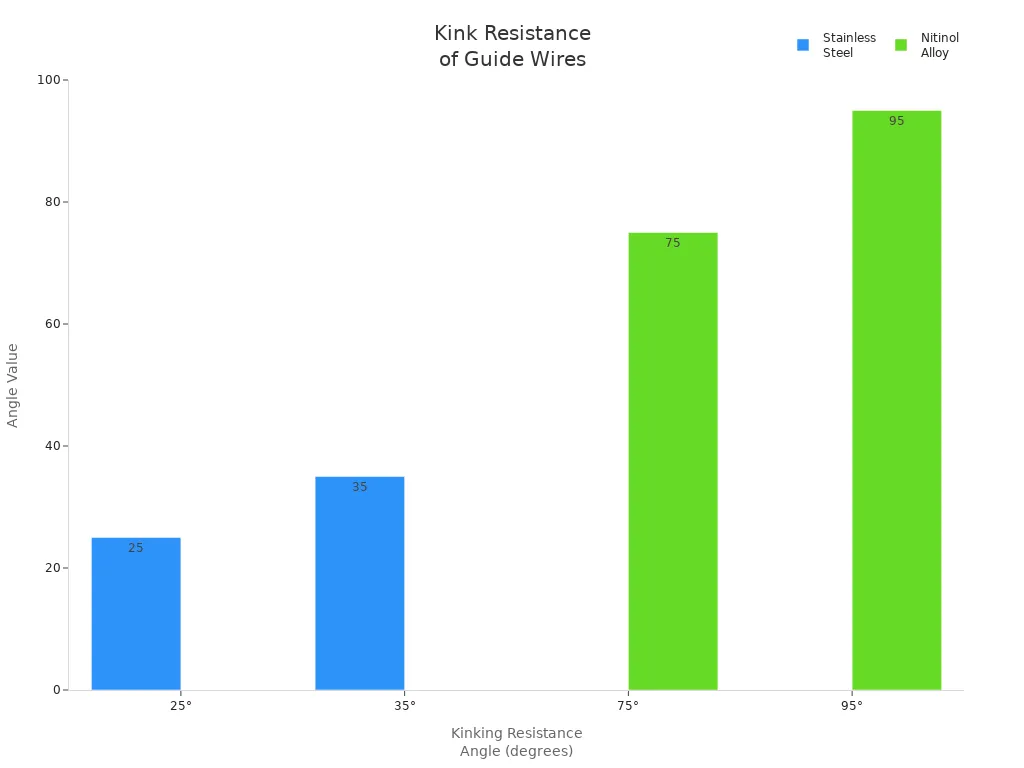
Kink resistance is another big benefit. Nitinol guide wires can bend much more than stainless steel wires. This means they keep the vessel open even in very twisted spots.
Material | Kinking Resistance Angles |
|---|---|
Stainless Steel | 25° and 35° |
Nitinol Alloy | 75° and 95° |
Comparison with Stainless Steel and Polymers
Doctors compare nitinol, stainless steel, and polymer wires. Each type has special features. Nitinol guide wires are very flexible and resist kinking. Stainless steel wires are stiffer and give better control. Polymer wires are soft but may not last long.
Material | Torqueability Characteristics |
|---|---|
Stainless Steel | Easier torque control, more rigid, better columnar support |
Nitinol | More flexible, kink resistant |
Stainless steel: Easy to control, stiff, and supports well.
Nitinol: Very flexible and does not kink.
Durability is important for guide wires. Nitinol guide wires are strong and last a long time. Super elastic nitinol guide wires do not break easily. They keep the vessel open after many uses. Polymer wires can break more often.
Property | Nitinol Guide Wire | Polymer-based Guide Wire |
|---|---|---|
Force to separate segments | 11.34 ± 2.14 N | 5 N (ISO standard) |
Tensile force to break | 30.97 ± 0.20 N | >30 N |
Force to detach tip coil | 19.24 ± 1.30 N | N/A |
Torque response | Comparable | N/A |
Cost is also important. Nitinol guide wires cost more than other wires. But they help lower problems later and keep the vessel open.
Material Type | Cost Implication | Long-Term Benefits |
|---|---|---|
Nitinol | 2-3× more expensive | Reduced long-term complications |
Other Materials | Less expensive | Potentially higher lifetime costs |
Nitinol guide wires have changed how doctors use guide wires. Doctors now use super elastic nitinol guide wires in many cases. These wires help keep vessels open and improve results. Nitinol guide wires also help make better guide wires for the future.
Kink-resistant nitinol tubing gives many benefits in small surgeries.
Flexibility and superelasticity help doctors move through tricky body parts.
Shape memory lets nitinol go back to its old shape, which helps doctors control tools.
Kink resistance stops the tube from getting damaged during surgery.
Biocompatibility means nitinol is safe to use again and again, helping patients get better.
Property | Benefit in Minimally Invasive Procedures |
|---|---|
Superelasticity | Helps doctors place tools and move them easily |
Shape Memory | Lets tubes move through tiny cuts |
Biocompatibility | Fewer bad reactions and safer surgeries |
Flexibility | Less harm to tissue in hard-to-reach places |
Nitinol keeps making small surgeries better, especially with robots and guidewires. Doctors see blood vessels heal faster and fewer problems with nitinol stents. Picking nitinol tubing can make surgeries safer and help patients do better.
FAQ
What makes nitinol tubes kink-resistant?
Nitinol tubes do not kink because they are superelastic. They also have shape memory. These features let the tubes bend and go back to their shape. Doctors use nitinol tubes in twisted vessels. The tubes stay open and do not collapse.
Where do doctors use nitinol tubes in the body?
Doctors use nitinol tubes in blood vessels and ureters. They also use them in other curved pathways. Nitinol tubes help guide wires and catheters. These tubes move through tight or twisted areas. This makes procedures safer and better for patients.
How does nitinol improve patient safety?
Nitinol keeps medical devices open and flexible. The tubes do not break or block easily. Doctors can move nitinol tubes in hard anatomy. This lowers the risk of injury and device failure.
Are nitinol tubes safe for long-term use?
Nitinol tubes are safe for most people. They have a layer that stops rust and nickel release. Doctors check patients for allergies or reactions. Most people do not have problems after surgery.
What is the difference between nitinol and stainless steel tubes?
Nitinol tubes bend more than stainless steel tubes. They resist kinking better. Stainless steel tubes can lose shape in tight spots. Nitinol tubes go back to their shape and last longer in medical work.
See Also
The Importance of Nitinol Tubing in Minimally Invasive Surgery
Nitinol Tubing's Impact on the Future of Medical Technology
Nitinol Tubing's Significance in Modern Medical Applications
Nitinol Tubing Transforming the Landscape of Medical Devices

© Copyright 2024 My First Blog - All Rights Reserved.