How to Identify Quality NiTi Tubing for Healthcare Applications

Quality NiTi tubing for medical use is important. It gives you tubing that bends and returns to shape. When you pick nitinol tubing, check if it is seamless or welded. Make sure the grade fits your medical device. Look at the surface finish and purity. Rough or dirty surfaces can cause problems. Biocompatibility keeps patients safe from bad reactions. Bad tubing can break, lose shape, or get tiny cracks from welding. Always use a careful method to pick nitinol tubing. Review nitinol tubing manufacturers USA before you choose.
Tip: Always ask for papers on what it is made of, how the surface looks, and if it is safe for the body before you pick medical tubing.
Key Takeaways
Pick seamless nitinol tubing for strong and reliable use. It does not have weak spots, so it works well in medical devices.
Make sure the nitinol tubing can handle lots of use and lasts long. This stops cracks from forming and helps it work for a long time.
Check that the nitinol tubing has a smooth surface and is very pure. These things lower the chance of problems and make it safer.
Confirm the tubing is the right size and meets strict rules. Good sizing helps the device fit and work the right way.
Always ask suppliers for paperwork and certifications. This shows the tubing is safe, high quality, and follows medical rules.
Key Criteria for Medical Grade Nitinol Tubing
When you pick medical grade nitinol tubing, you should look at a few important things. These things help the tubing work well in healthcare. You want tubing that is strong, bends easily, and is safe for people. Good nitinol tubing helps medical devices work their best.
Superelasticity and Shape Memory
Superelasticity and shape memory make nitinol special. You can bend or twist nitinol tubing, and it goes back to its shape. This is very helpful for stents, guidewires, and other devices that move inside the body. Shape memory lets the tubing return to its shape after heat changes it. This helps the tubing fit the body’s curves and work in small spaces. Superelasticity and shape memory also make the tubing easier to use in surgery. You can count on the tubing to work right, even in tight places.
Fatigue Resistance and Durability
Medical grade nitinol tubing needs to handle lots of bending and stretching. Fatigue resistance and durability are important for tubing that moves inside the body. You want tubing that does not crack or break after many uses. Experts test nitinol tubing by bending it over and over. They check how long it lasts and when cracks show up. Tubing with good fatigue resistance and durability lasts longer and keeps people safe. This lowers the chance of the device breaking and helps it work better.
The durability of nitinol tubing is checked by:
Bending and stretching it many times.
Seeing how long it lasts before wearing out.
Looking for cracks or weak spots after many bends.
Always pick tubing that has high fatigue resistance and durability. This makes sure your device works well for a long time.
Surface Finish and Purity
Surface finish and purity are very important for safe and strong nitinol tubing. Smooth and pure tubing helps stop problems in the body. Seamless tubing is better than welded tubing because it has fewer weak spots. A smooth surface makes it easier to move tubing through blood vessels.
Different surface treatments can make nitinol tubing safer and work better. Here is a table that shows how some treatments help:
Treatment Method | Benefits | Impact on Safety and Performance |
|---|---|---|
Electropolishing | Makes the surface smooth, lowers nickel ion release | Makes tubing safer for the body and lowers allergies |
Coatings | Stops protein and platelet from sticking | Lowers blood clot risk and keeps blood flowing |
Anodization | Adds a strong titanium oxide layer | Stops rust and helps tubing last longer |
Surface Treatments | Stops rust and keeps tubing strong | Makes tubing safe and work well in medical use |
You can see how surface treatments help stop blood clots and help healing:
Surface treatments lower blood clots by stopping protein from sticking.
Coatings can let out nitric oxide or special proteins to keep blood moving.
Treated tubing gets fewer clots, so it works better with blood.
Purity is just as important as a smooth surface. Medical grade nitinol tubing must be very pure. Bad stuff in the tubing can make it rust and let out more nickel, which can cause allergies. Here is a table that shows the most allowed amount of each element in medical grade nitinol tubing:
Element | Limit |
|---|---|
Fe | ≤ 0.05 |
Ni | 54.5 - 57.0 |
Cr | ≤ 0.01 |
Cu | ≤ 0.01 |
Nb | ≤ 0.025 |
C | ≤ 0.05 |
Ti | Balanced |
Co | ≤ 0.05 |
N + O | ≤ 0.050 |
H | ≤ 0.005 |
You can also look at this chart to see the highest amount of each element in medical grade nitinol tubing:
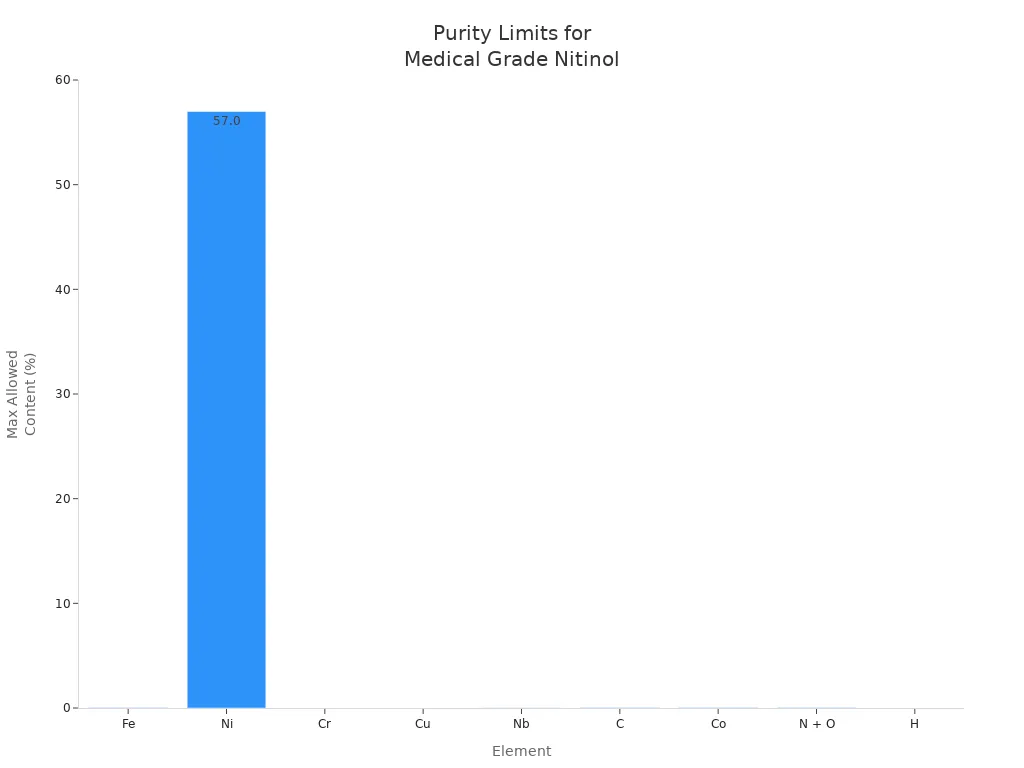
Picking nitinol tubing with the right surface and purity helps you meet tough medical rules. It also makes your device safer and work better. Always check that your tubing is pure and has a smooth, clean surface.
Note: Seamless nitinol tubing that is pure and smooth helps you stop device problems and meet the best standards for medical tubing.
If you focus on superelasticity, shape memory, fatigue resistance, durability, surface finish, and purity, you can pick nitinol tubing that works well. These things make sure your tubing is safe and works right in healthcare.
Dimensional Precision and Tolerances in Medical Tubing
Sizing for Medical Devices
It is important to pick the right size nitinol tubing. The correct size helps your device fit inside the body. Nitinol tubing comes in many different sizes. You can choose the one that matches your needs. The outer diameter, inner diameter, and wall thickness all matter. These features help your device move well and stay strong.
For neurovascular stents, you must check certain size details. The table below shows what is needed for these devices:
Feature | Group 1 | Group 2 |
|---|---|---|
OD Range | .065-.197" (1.65 - 5 mm) | >.198" (>5 mm) |
OD / ID Ratio | > 1.08 | > 1.08 |
OD Tolerance | + .0005" (12.7 um) | + .0008 to .001" (20.3-25.4 um) |
Concentricity Tolerance | > 90% | > 90% |
Nitinol tubing for medical use must meet strict size rules. These rules help the tubing keep its shape and work well. Always check the size to make sure it fits your device.
Tolerance Requirements
Tolerance is how much the size can change from the goal. Tight tolerances help your tubing work better and last longer. You want nitinol tubing with very small changes in size. This keeps your device safe and reliable. Good performance depends on tight tolerances.
Manufacturers do several things to keep tubing within the right size:
They use special ways to control the size of nitinol tubing.
They have strict quality checks at every step.
They test the tubing’s strength and look for problems.
They check each batch to make sure it meets the rules.
Tip: Always ask your supplier for test and inspection papers. These papers show your nitinol tubing meets the right size rules for medical use.
Choosing nitinol tubing with tight tolerances helps your device work better. It also lowers the chance of device failure. Good size control is key for the best tubing performance. Always focus on these details to make sure your nitinol tubing is right for your medical use.
Biocompatibility and Regulatory Standards
Biocompatibility Testing and Documentation
You must make sure nitinol tubing is safe for the body. Biocompatibility is very important for patient safety. When you pick medical tubing, you want to know it will not hurt anyone. Biocompatibility testing checks if nitinol tubing is safe to touch blood or tissue. This testing is needed for all medical devices.
In the United States, there are strict rules for biocompatibility testing. The FDA uses ISO 10993-1 as the main rule. This standard helps you know which tests to do. It depends on how long and where the tubing touches the body. Some tests check for cytotoxicity, genotoxicity, carcinogenicity, and systemic toxicity. These tests help prove your nitinol tubing is safe and will not cause allergies.
Here is a table that shows the main parts of biocompatibility testing for medical tubing:
Testing Aspect | Description |
|---|---|
Standard Reference | ISO 10993-1, used by U.S. manufacturers for biocompatibility testing of medical devices. |
Guidance Issued | The Tripartite Biocompatibility Guidance for Medical Devices was released in 1986. |
Testing Categories | Tests are specified based on device contact type and duration with bodily tissues. |
Types of Tests Included | Genotoxicity, carcinogenicity, reproductive toxicity, cytotoxicity, systemic toxicity, etc. |
Purpose of Standard | Offers guidance for medical device design rather than a strict checklist for qualification. |
International Variations | U.S. follows FDA's ISO 10993-1, while Europe uses the original ISO 10993 standard. |
You should always ask your supplier for full paperwork. This paperwork proves the nitinol tubing passed all the needed tests. Good records help you show that your tubing is safe for patients.
Note: Biocompatibility testing keeps patients safe and helps you follow medical rules.
Certifications for Medical Grade Nitinol Tubing
Certifications show that nitinol tubing meets top safety and quality standards. You want proof that your tubing is made with the right materials and steps. Two main standards guide you: ASTM F2063 and ISO 10993.
Here is a table that explains how these standards apply to nitinol tubing:
Standard | Application |
|---|---|
ASTM F2063 | Standard for medical nitinol properties |
ISO 10993 | Biocompatibility testing for tissue contact |
ASTM F2063 sets the rules for nitinol’s makeup, purity, and strength. This standard helps you check the nickel and titanium levels. ISO 10993 covers biocompatibility testing for tubing that touches the body. Both standards work together to keep your tubing safe and strong.
You must check that your nitinol tubing supplier follows these rules. Ask for certificates and test reports. These papers prove the tubing meets all safety and purity needs. You also want proof of sterilization and strength testing. This helps you trust the tubing will work well in medical devices.
Tip: Always check the makeup and purity of your nitinol tubing to meet rules and keep patients safe.
When you pick tubing with the right certifications, you help make sure your medical devices are safe, strong, and work well.
Evaluating NiTi Tubing Manufacturers USA
Supplier Experience and Quality Systems
When you look for nitinol tubing manufacturers USA, pick a company with lots of experience. The supplier should know how to make nitinol tubing for medical devices. Check how long they have worked with nitinol. Make sure they understand what medical devices need. Good suppliers make tubing that lasts a long time. Their tubing has strong fatigue resistance and keeps its shape. These things help your medical devices work better and last longer.
Quality management systems are very important for nitinol tubing. Suppliers with ISO9001:2015 and ISO13485:2016 certifications follow strict rules. These rules help test and keep tubing safe. The systems control every step, from making nitinol to checking the tubing. You can trust tubing from these suppliers. Their tubing has the right durability and purity for medical use.
Here is a table to help you compare nitinol tubing manufacturers USA:
Criteria | Description |
|---|---|
Product Quality & Performance | Check durability, fatigue resistance, and shape memory in real-world medical use. |
Customization & Flexibility | See if they offer custom nitinol tubing sizes and finishes for your medical project. |
Supply Chain & Scalability | Make sure they can handle big orders without losing quality. |
Innovation & R&D | Look for new nitinol alloys and better processing methods. |
Regulatory Compliance | Confirm ISO and FDA approvals for medical nitinol tubing. |
Pricing & Cost Efficiency | Compare prices and see if they match the quality and durability you need. |
Customer Support & Service | Ask about technical help and after-sales support for medical tubing. |
Reputation & Track Record | Look for a history of successful medical projects and happy customers. |
Documentation and Traceability
You need good paperwork when you buy nitinol tubing for medical devices. Good nitinol tubing manufacturers USA give you clear documents. These papers show what the tubing is made of and how it was tested. They also show certifications. These documents prove the tubing is strong, pure, and safe.
Traceability is also very important for medical nitinol tubing. You should be able to track each batch from start to finish. This helps you find problems quickly and keeps your devices safe. Suppliers with ISO 13485 and ASTM F2063 certifications care about quality and traceability.
Here are steps you can follow to check documentation and traceability:
Ask for certificates like ISO 13485, ISO 9001:2015, and ASTM F2063 for medical nitinol tubing.
Request test reports that show durability, fatigue resistance, and purity.
Review shipping and batch records to track your nitinol tubing from start to finish.
Request samples to test the nitinol tubing before you buy large amounts.
Tip: Always look at all documents and test reports before you pick a supplier. This helps you make sure your medical devices use safe and strong nitinol tubing.
If you follow these steps, you can pick nitinol tubing manufacturers USA who give you high-quality nitinol tubing for medical use. You will get tubing with the right durability, purity, and certifications for your medical devices.
Application-Specific Selection of Nitinol Tubing
Matching Tubing Type to Medical Use
You have to pick nitinol tubing that fits each medical device. Some devices, like stents and catheters, need tubing that meets tough rules. The tubing should bend easily but still be strong. It must work well with neurovascular procedures. Nitinol tubing has to fit inside tiny blood vessels and move without problems. Devices that stay in the body for a long time need tubing that is very safe.
Here is a table that shows what to check when picking nitinol tubing for neurovascular stents and catheters:
Factor | Description |
|---|---|
Biocompatibility | Nitinol works well with human tissue and helps stop bad reactions. This is very important for stents in the brain. |
Fatigue Resistance | Nitinol tubing can handle lots of bending and stretching. This helps stents last a long time. |
Dimensional Considerations | The tubing must be the right size and shape. This helps stents move through tricky blood vessels. |
Wall Thickness | Thin walls make tubing bend better. But it still needs to be strong enough to hold its shape. |
Precision and Tolerances | The tubing must be made very carefully. Even small mistakes can make stents not work right. |
You can ask for special sizes, wall thickness, or surface finishes. This helps you get tubing that fits your device perfectly. Custom tubing makes sure your device works well for neurovascular procedures.
Niti Hypotube and Specialized Applications
Nitinol tubing comes in different types. Niti hypotube is a special kind used in advanced medical devices. You use niti hypotube when you need tubing that bends and goes back to its shape. This is important for devices that move through small spaces in the body. Nitinol can return to its shape after bending, so your device works well in many situations.
Thin-wall nitinol tubing is made with care. This makes tubing that is safe for the body and lasts a long time. It is flexible and strong, so it works well for neurovascular procedures.
It bends easily and does not kink.
The surface is smooth for better control.
It does not rust in body fluids.
It is safe for use in medical devices.
It stays strong at different body temperatures.
You can use nitinol tubing for endoscopic tools, surgery tools, and implants. Custom tubing lets you pick what you need for each device. This gives you better results for every neurovascular device.
Tip: Always talk to your supplier about custom tubing. You can get nitinol tubing that fits your device and works well for neurovascular procedures.
You can find good nitinol tubing for medical use by using clear steps. First, vacuum induction melting helps make nitinol very pure. Then, thermomechanical processing gives the tubing the right shape memory and strength. Chemical etching and electropolishing make the surface better for the body. Always use non-destructive tests and chemical analysis to check the tubing. Make sure the tubing’s properties and certifications fit your medical device. Work with trusted manufacturers who follow ASTM F2082 and ISO 13485. Always look at all documents and test reports to keep your nitinol tubing safe and reliable.
FAQ
What is the difference between seamless and welded NiTi tubing?
Seamless tubing does not have any weld lines. This makes it stronger and more dependable. Welded tubing can have weak spots. Seamless tubing is better for medical devices. It gives more strength and bends without breaking.
How do you check if NiTi tubing is medical grade?
You should ask for certificates like ASTM F2063 and ISO 10993. These papers show the tubing is safe for medical use. Always look at test reports for purity, strength, and biocompatibility.
Why does surface finish matter for medical NiTi tubing?
A smooth surface lets tubing move easily in the body. It helps lower the chance of blood clots and infection. You should pick tubing with electropolished or coated surfaces for best results.
Can you use NiTi tubing for implants?
Yes, you can use NiTi tubing for implants. The tubing must be biocompatible and meet all medical rules. Always check for testing and certifications before using it in the body.
See Also
Understanding Nitinol Tubing Uses in Medical Technology
The Manufacturing Process of Nitinol Tubing for Healthcare
The Importance of Nitinol Tubing in Modern Medicine

© Copyright 2024 My First Blog - All Rights Reserved.