The Complete Guide to Hypotubes: Applications, Materials, and Manufacturing Processes

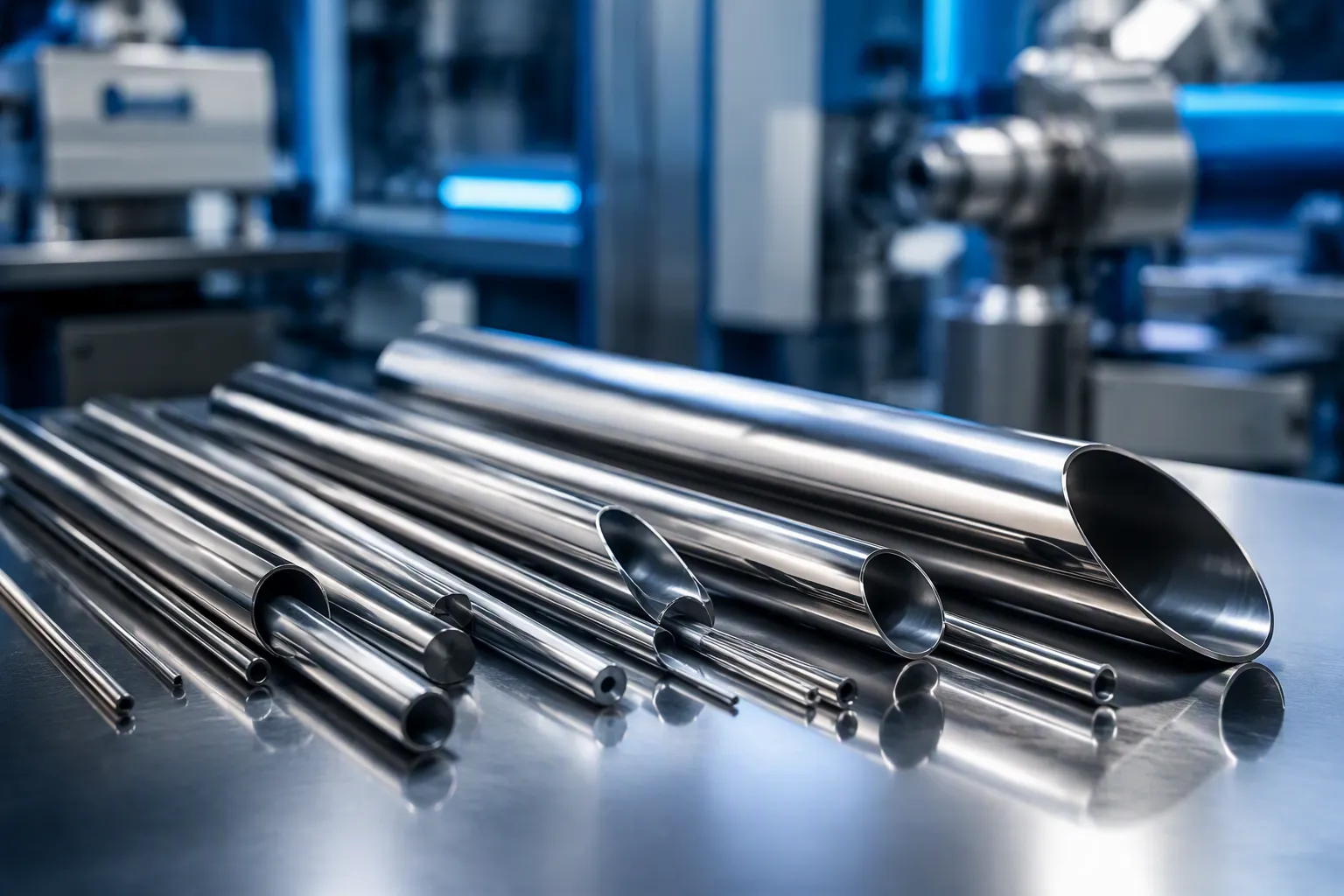
A hypotube is a tiny metal tube made with great precision. It serves as the main support for modern medical tools. This part allows doctors to do less invasive surgery, which means less harm to patients. The worldwide hypotubes market hit USD 1.2 billion in 2024, growing 9.0% each year until 2033.
Not every hypotube works the same way. A good hypotube has a PTFE coating so it moves more smoothly. This guide looks at the materials, uses, and production of top-quality hypotubes. High-precision engineering makes interventional tools better for less invasive surgery.
Each hypotube meets a specific medical need. Stainless steel gives strength; Nitinol offers flexibility. Knowing how hypotubes are designed helps you pick the right part for your catheters. Good manufacturing decides how well it performs. This article gets you ready for your next device project.
Key Takeaways
Hypotubes allow minimally invasive surgery with outer diameters as small as 0.25 mm.
Stainless steel is strong and easy to push forward, while Nitinol can bend and twist without breaking.
PTFE coating lowers friction and reduces blood clot risk, making devices easier to move and safer to use.
Making products requires very precise laser cutting and assembly in a clean room to keep quality the same every time.
Check that suppliers have important certifications, such as ISO 13485, to make sure their materials are safe for the body and meet all rules.
What is a Hypotube?
A hypotube is not regular tubing. It belongs to a special group called high-precision thin-walled metal tubes. These parts support modern medical devices in ways that standard tubing cannot.
Defining Hypotubes and Their Core Characteristics
Standard tubing has larger diameters and thicker walls. Hypotubes work at a much smaller scale. You can find hypotubes with outer diameters as small as 0.006 inches (0.25 mm). Their walls can be just 0.001 inches (0.038 mm) thick. Tolerances usually stay at ±0.0002 inches (5 µm). This high precision makes them useful for tiny applications like microcatheters.
The industry recognizes hypotubes through dedicated standards. ASTM A908 covers needle tubing. ISO 9626 gives detailed dimensional, chemical, and mechanical specs. These standards differ from those used for regular catheters, which follow ISO 10555. Separate standards show that hypotubes serve special roles that need exceptional precision.
The Role of Hypotube in Catheter Systems
A hypotube in catheter systems acts as the structural backbone. Hypotubes provide pushability to move the device forward. You need torque transmission to steer through vessels. You need kink resistance to handle tight bends. This hypotube design directly affects how your catheter performs.
Kink resistance means the hypotube keeps its round shape when bent around a tight curve. This property keeps the lumen open during navigation through sharp vascular bends.
Several features support this performance:
Keeps lumen shape: the round profile stays intact even in tight bends, allowing smooth device passage.
Bends predictably: the moment-curvature relationship stays linear without sudden shape collapse.
Low friction: the round cross-section reduces resistance with inner devices.
Better steering: torsional rigidity and buckling resistance prevent flattening during complex moves.
These features matter for catheter-based procedures. Your device must reach the target site reliably. A hypotube that kinks can block the lumen. The right design ensures your catheter works predictably through winding paths. Medical teams depend on these devices for consistent results.
Hypodermic tubing for medical needles shares similar principles with hypotubes. Both need precise dimensions and consistent material properties. When you choose a hypotube for your device, you pick a part for demanding clinical use. The precision built into each tube directly affects procedure success and patient outcomes.
Materials Used in Hypotubes
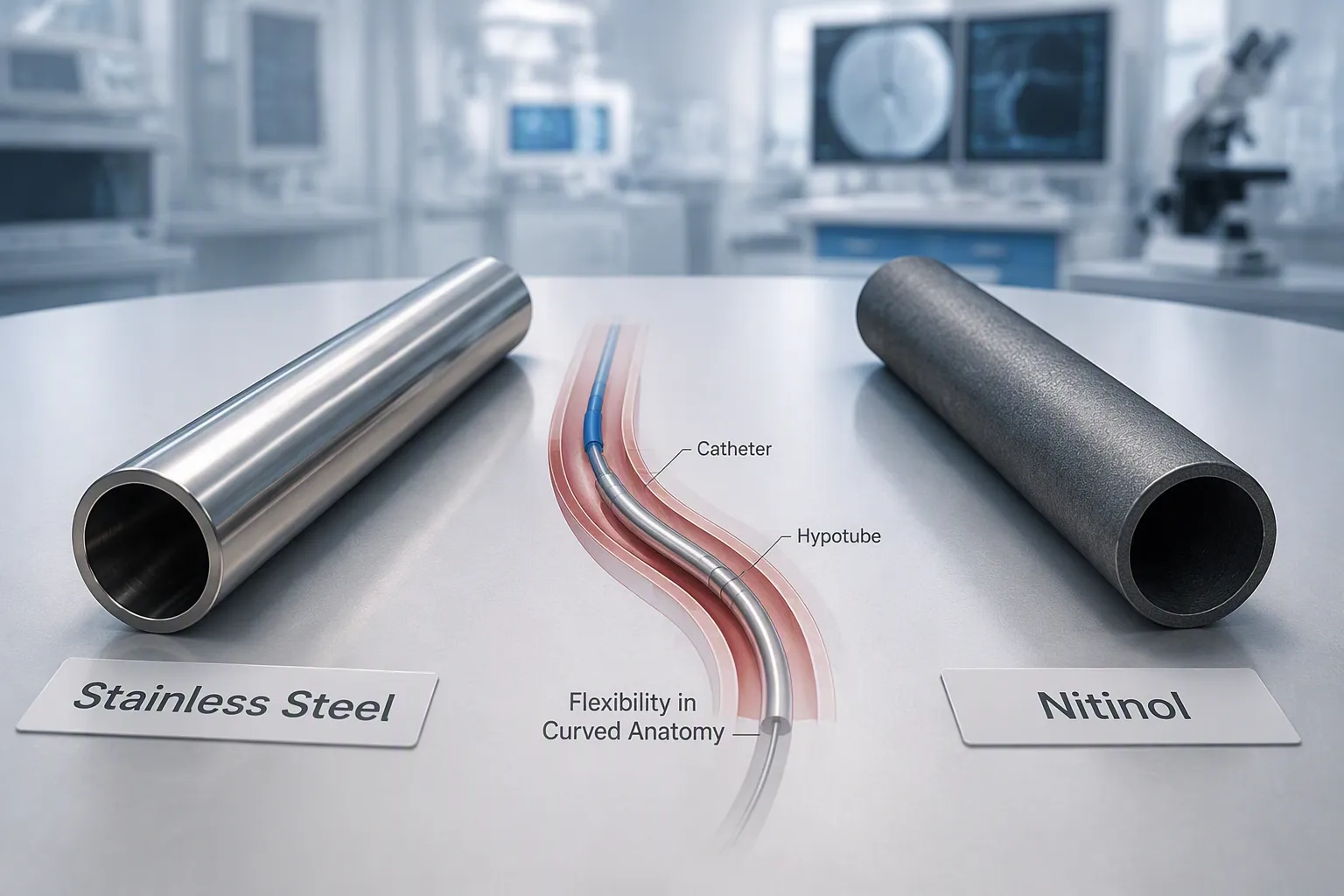
Choosing the right material for your hypotube decides how well your device works inside the body. Each material has its own mechanical properties, biocompatibility, and processing traits. You need to match these traits to your specific clinical use.
Stainless Steel: The Workhorse Material
Medical grade stainless steel leads the hypotube market. You will find several grades, each for a different job. The table below shows the key differences:
Material | Key Strength | Best Application |
|---|---|---|
304 Stainless Steel | High cost performance, easy processing | Routine cardiovascular procedures |
316LVM | Excellent corrosion resistance | Neurovascular, longer-dwell devices |
L605 Co-Cr | High strength, fatigue resistance | Stent delivery, challenging lesions |
304 stainless steel has moderate rigidity. This material suits short-term procedures with low fatigue needs. But 304 lacks fatigue resistance. Repeated bending can cause structural failure. It also lacks corrosion resistance for long-term use. For those cases, 316LVM offers better anti-corrosion properties.
The choice between these materials affects your device's pushability and torque transmission. Stainless steel hypotubes give excellent push force. They transmit torque reliably along their length. These traits make stainless steel the top pick for many catheter systems.
Nitinol and Advanced Polymer Coatings
Nitinol brings different traits to hypotube design. This nickel-titanium alloy shows superelasticity. It recovers up to 8% elongation, while stainless steel recovers only 0.8%. This special property lets Nitinol hypotubes move through twisted neurovascular paths without permanent damage.
Property | Nitinol | Stainless Steel |
|---|---|---|
Recovered elongation | 8% | 0.8% |
Effective modulus | ~48 GPa | 193 GPa |
Torqueability | Excellent | Poor |
Biocompatibility | Excellent | Fair |
Nitinol's lower modulus gives better flexibility and kink resistance. Its maximum permanent set after 6% strain stays at or below 0.3%. The tube returns to its original shape after bending. Ultimate tensile strength reaches at least 1070 MPa. Austenite finish temperature ranges from -10°C to +15°C, confirming superelastic behavior at body temperature.
Beyond the base metal, surface coatings change hypotube performance. PTFE coating cuts friction dramatically. This low-friction surface allows smoother movement through vessels. It also reduces thrombogenicity, lowering the risk of clot formation.
You can customize PTFE coatings in thickness from 4 to 10 micrometers. Color options include black, blue, green, yellow, and purple. These choices help you tell apart different device sections during procedures.
The choice of materials and coatings directly affects patient outcomes. A hypotube with the wrong material may kink or fail during navigation. The right mix ensures smooth delivery and reliable performance. Your material choice must account for the specific anatomy you target and the mechanical demands of your procedure.
High precision manufacturing matters here. Each hypotube must meet tight tolerances for consistent clinical results. The precision of the base material and coating application affects device reliability. Medical device engineers must weigh these factors carefully before finalizing their hypotube specifications.
Medical Applications of Hypotubes
Hypotubes support many interventional tools used in medicine. Their precise design lets doctors perform complex procedures through very small cuts. These tubes are used in many medical fields, from heart care to ear, nose, and throat treatments. Each use needs specific materials and coatings. Your choice affects how well the procedure works and how the patient recovers.
Cardiovascular and Neurovascular Interventions
Heart procedures depend heavily on hypotube technology. Angioplasty catheter systems need hypotubes that resist kinking and keep their shape under pressure. You need strong tensile strength from 304 or 316 stainless steel to push force from one end to the other. The table below shows typical sizes for these important parts:
Parameter | Value Range |
|---|---|
Hypotube outer diameter | 0.59–0.69 mm |
Hypotube wall thickness | 25–47 µm |
Stent delivery systems also use laser-cut hypotubes. Boston Scientific added a laser-cut, stainless-steel hypotube to their stent-delivery system to improve flexibility and deliverability. This design keeps the stent very thin while staying strong enough to move through vessels. The connection between the metal hypotube and the flexible plastic tip needs a tapered stiffening wire or a skived hypotube. This stops kinking and creates a smooth stiffness change.
Diagnostic imaging catheters also gain from hypotube precision. These tools let doctors push, guide, and rotate instruments through narrow and twisted body paths. Laser-cut patterns give 1:1 torque transmission and keep the lumen open. You can add different patterns into one single piece, reducing the need for multiple durometer jackets.
Peripheral and ENT Procedures
Peripheral artery treatments need special hypotube designs. The Lightning Bolt® 7 catheter shows this approach with its laser-cut, atraumatic hypotube. It makes the inner diameter as large as possible while keeping the outer diameter small. A distal TORQ tip allows circular movement during procedures.
ENT treatments are another growing use of hypotubes in surgery. Sinus dilation balloons use hypotubes to move through the complex nasal passages. The low-friction PTFE coating allows smooth movement through delicate tissues. This reduces harm and helps patients heal faster.
The choice of material and coating depends on the use. Stainless steel gives pushability for straight paths. Nitinol offers superelasticity for twisted routes. Your choice of these interventional tools must consider the mechanical needs of each procedure. Medical treatments keep improving, and hypotubes change to meet new challenges in minimally invasive surgery.
Hypotube Manufacturing Process
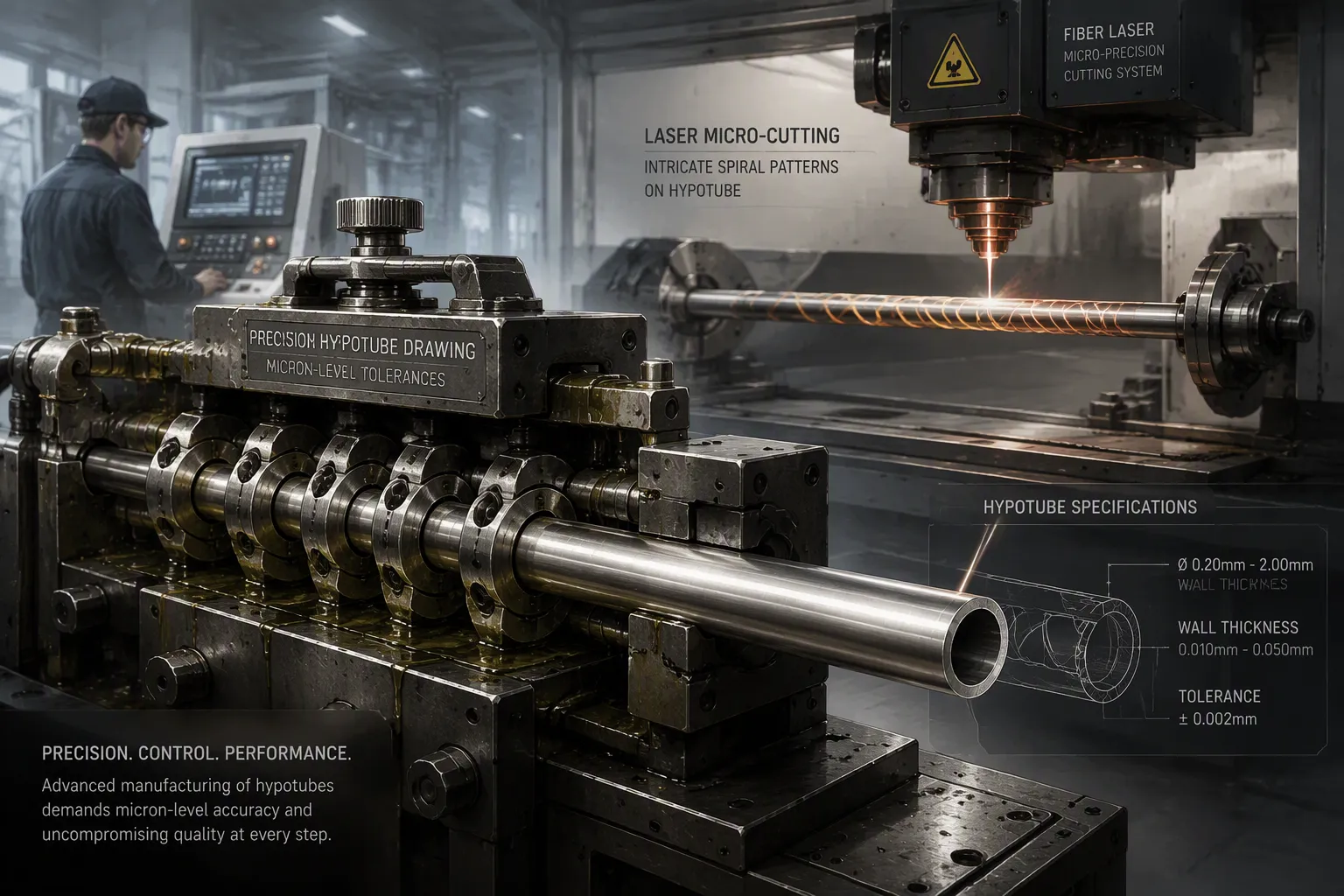
Making a hypotube requires very careful control at every step. You need precision measured in microns, not millimeters. Each step builds on the last one, turning raw metal into a part that works perfectly inside the human body.
Precision Forming and Laser Cutting
The process starts with tube drawing. Manufacturers pull stainless steel or Nitinol through smaller and smaller dies to get the final size. This cold-working method makes the metal stronger while making it thinner. Most hypotubes have outer diameters from 0.3 to 1.20 mm with wall thicknesses between 0.05 and 0.18 mm. Size tolerances stay tight at ±0.006 mm, so every batch comes out the same.
The forming process needs careful control of speed, temperature, and lubrication. Each pass through a die shrinks the tube a little. Reducing it too fast can cause cracks or thin walls. Skilled operators watch every setting to keep wall thickness and surface quality even.
Once forming is done, laser cut hypotubes come next. This step creates the complex patterns that give your device its flexibility. The laser removes material in exact patterns along the tube wall. These patterns turn a stiff tube into a flexible shaft that still turns and pushes well.
Several pattern types serve different clinical needs:
Interrupted spiral cuts balance flexibility with column strength
Brickwork patterns use parallel lines of interrupted cuts that look like wall stones
Continuous spiral cuts give uniform bending behavior
Puzzle piece and dogbone shapes offer special mechanical properties for steerable devices
The interrupted spiral pattern deserves extra attention. Its cut length and spacing set how stiff the tube stays. Longer cuts with tighter spacing create more flexibility. Shorter cuts with wider spacing keep more rigidity. You can adjust these settings to place flexibility exactly where you need it along the shaft.
High-precision laser systems make these detailed cuts possible. CNC-controlled equipment ensures repeatability with documented tolerances down to ±0.01 mm for hypotube patterns. Stage repeatability reaches sub-micron levels, meaning each cut lands exactly where the design says. This precision is vital for correct surgical performance.
The CNC-controlled laser cutting process ensures repeatability and tight tolerances, with a documented capability down to ±0.01 mm for hypotube patterns.
Laser cut hypotubes use complex, custom patterns that boost flexibility, torque, and kink resistance all at once. Engineers can create custom hypotube designs that vary flexibility along the shaft length. This tailoring allows precise control for specific clinical uses.
Coating, Cleaning, and Final Assembly
After laser cutting, your hypotube needs surface treatment. PTFE coating happens in a controlled environment. The coating thickness ranges from 4 to 10 micrometers, based on your needs. This low-friction layer allows smooth movement through vessels and reduces clot risk.
The coating process needs a cleanroom environment. Class 10,000 cleanrooms keep strict particle control. This classification limits particles larger than 0.5 microns to 10,000 per cubic foot of air. Such conditions stop contamination that could harm micron-level surfaces.
Cleanroom Control Measure | Direct Support for Hypotube Coating & Assembly |
|---|---|
Controlled personnel & material flow | Stops particles from getting onto micron-level surfaces |
Dedicated cleanroom zones | Keeps coating and assembly separate to reduce cross-contamination |
Enclosed PTFE coating booth | Traps fumes while achieving precise thickness control |
Continuous environmental monitoring | Keeps conditions stable for coating adhesion and dimensional accuracy |
Cleaning follows coating as a key step. Leftover oils, debris, or particles from earlier steps must be removed completely. Manufacturers use special cleaning solutions and ultrasonic baths to reach medical-grade cleanliness. This step directly affects biocompatibility and device safety.
Final assembly and inspection finish the manufacturing process. Each hypotube goes through dimensional checks, visual inspection, and functional testing. Quality checks confirm that coating thickness meets specs and patterns match design intent. Only tubes that pass every inspection move on to packaging.
The whole process needs careful documentation and traceability. You need confidence that every hypotube in your shipment meets the same high standards. This consistency comes from well-controlled processes and strong quality systems. When you pick a manufacturing partner, look closely at their cleanroom protocols and inspection abilities. These details decide whether your final device works reliably in clinical use.
Quality and Compliance in Hypotube Manufacturing
Ensuring Safety Through Certifications
Medical devices must meet strict safety rules. You need to trust that every hypotube in your catheter system follows regulatory requirements. Several certifications build this trust.
ISO 13485 is the main certification for medical device quality. This global standard covers all parts of production, from design to delivery. ISO 10993 checks biocompatibility, making sure materials are safe with human tissue. USP Class VI certification also confirms material safety for devices that stay in the body for a long time.
Environmental rules matter too. REACH testing looks for 233 harmful substances. PFAS testing checks for 61 per- and polyfluoroalkyl substances. These tests confirm your hypotube has no dangerous chemicals. RoHS compliance makes sure restricted hazardous substances stay out of the final product.
Check that your supplier holds these certifications. Ask for certificates and audit reports. A manufacturer that invests in compliance shows a commitment to patient safety. These credentials protect you when you submit your own devices for regulatory approval.
The Importance of a Robust Quality Management System
Certifications alone do not ensure quality. A strong quality management system puts those standards into daily practice. You need a supplier whose processes follow a clear workflow from start to finish.
Quality starts with your request for quotation. A full RFQ and CAD review sets tolerance baselines and finds possible drawing gaps. Prototype builds follow, using laser cutting and finishing with sample-lot controls. First article inspection then checks dimensions through microscopic review and critical-to-quality checks. Finally, scale-up release manages revision control and outgoing records.
Device classification shapes the compliance level you need. Full-medical-grade hypotubes meet ISO 9001 and ISO 13485 standards. Industrial-grade tubes serve non-medical uses. Custom-premium options provide extra inspection for high-risk devices. You must match the classification to your clinical use.
Raw material traceability is another key part of quality control. Suppliers must document where every alloy batch comes from. Only medical-grade materials like 304 stainless steel, 316L, or Nitinol enter production. Laser process settings stay locked and calibrated to prevent drift in cut geometry. Post-processing steps remove micro-burrs and particles.
In-house testing speeds up your validation timeline. A CNAS-accredited laboratory provides physical, chemical, and microbial analysis on-site. This means faster answers to your quality questions. You avoid delays from outsourcing critical tests. Finished-part testing checks push performance, torque transmission, and kink resistance. Full documentation supports your regulatory submissions to the FDA or MDR authorities.
A manufacturer with strong quality processes delivers consistent hypotubes every batch. This reliability protects your device performance and your patients.
Hypotubes form the backbone of modern interventional devices. Your choice of material, coating, and manufacturing partner directly impacts device performance and patient safety. Stainless steel provides strength; Nitinol offers flexibility. PTFE coatings reduce friction for smoother navigation during surgery.
Selecting the right hypotube requires careful evaluation. Look for a manufacturer with proven expertise, ISO 13485 certification, and commitment to customization. Precision manufacturing and stringent quality control ensure consistent results across every batch.
Medical devices continue evolving toward smaller, more flexible designs. Advanced hypotube technology drives this progress, improving patient outcomes across cardiovascular, neurovascular, and ENT applications. Partner with a supplier that invests in innovation. Explore customized solutions for your next project and deliver better surgical tools to clinicians worldwide.
FAQ
What makes a hypotube different from standard tubing?
A hypotube has very thin walls, often less than 0.1 mm. Standard tubing has thicker walls. Tight tolerances give you pushability and torque for catheter systems. You find them in many medical applications.
When should you choose Nitinol over stainless steel for your hypotubes?
Choose Nitinol for twisted body paths. It can recover up to 8% elongation. Stainless steel recovers only 0.8%. Use stainless steel for straight paths where pushability matters most.
How does PTFE coating improve device performance?
PTFE coating creates a low friction surface. This helps smoother movement through vessels. It also lowers thrombogenicity, reducing clot risks. You can pick coating thickness from 4 to 10 micrometers.
What certifications should you verify with your supplier?
Look for ISO 13485 for quality management. Check ISO 10993 for biocompatibility. Verify USP Class VI for long-term body contact. Also confirm REACH and PFAS compliance for environmental safety.
See Also
Comprehensive Overview of Nitinol Parts and Production Methods
Latest Innovations in Laser-Cut Hypotubes for Upcoming Year
Full Resource on Producing Nickel Titanium Alloys
Detailed Process for Creating Nitinol Microtubes for Brain Vessels

© Copyright 2024 My First Blog - All Rights Reserved.